
TL;DR

Get tools and workshop supplies delivered free — and shop member deals
- Fast, free delivery on millions of items
- Access to Prime Big Deal Days deals on October 6–7
- Prime Video, Amazon Music and more included
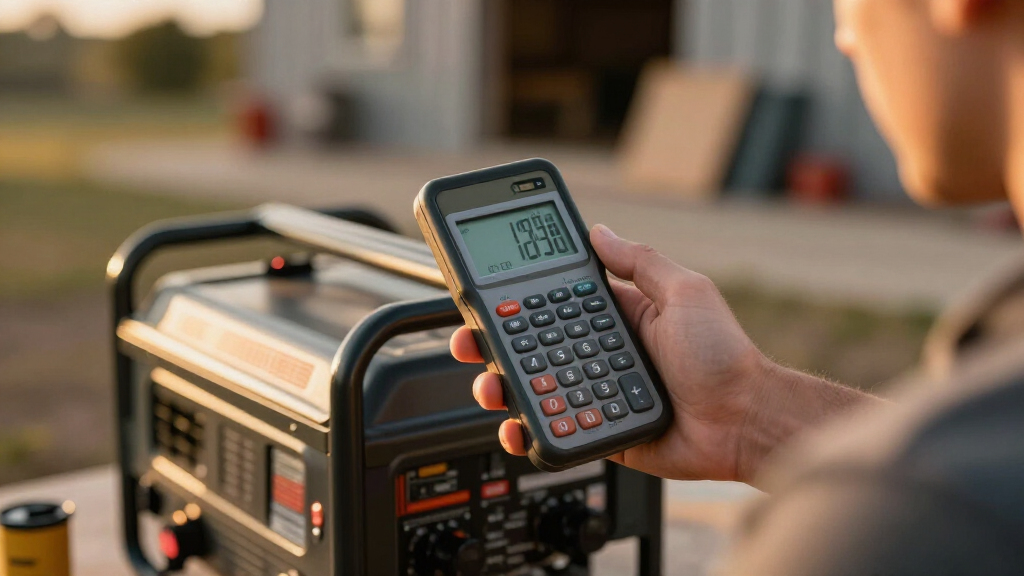
A generator wattage calculator estimates the power you need by combining your total running watts plus the largest startup surge. Adding a safety margin ensures your generator can handle all your essential appliances comfortably.
Imagine losing power in the middle of a storm. Your generator kicks in, but nothing runs smoothly. The secret to avoiding that frustration? Picking the right size from the start.
That’s where a generator wattage calculator comes in. It helps you understand exactly how much power your essential appliances need, so you don’t waste money on oversized units or risk overload with too-small ones. Let’s break down how to use it, with real-world tips and examples that make the process simple.
Always include both running and starting watts for each appliance.
Add a 15-25% safety margin to your total load estimate.
Use a comparison table to decide between portable and inverter generators based on your needs.
Check appliance labels or use a power meter for precise wattage data.
Size your generator for the maximum load plus buffer — don’t guess or assume.
What a generator wattage calculator actually does for you
A generator wattage calculator estimates the size you need based on your appliances and tools. It considers both the constant power draw (running watts) and the temporary surge when motors start (starting watts). For example, a refrigerator runs at about 700 watts but needs over 2,200 watts to start. The calculator helps you add these up accurately.
Instead of guessing, you input your appliances’ wattage, and it tells you the minimum generator size. This prevents overspending or, worse, choosing a generator that stalls under load.
Understanding this process is crucial because selecting a generator too small means risking frequent overloads, which can damage your appliances or trip circuit breakers. Conversely, opting for a larger generator than necessary results in unnecessary expense and fuel consumption. The calculator helps you find a balanced size, ensuring efficiency and reliability, especially during critical outages.
portable inverter generator 5000 watts
As an affiliate, we earn on qualifying purchases.
As an affiliate, we earn on qualifying purchases.
How to use a generator wattage calculator in 3 steps
- List all essential appliances and tools you want to power. Include their running and starting watts from the nameplate or manuals.
- Input the wattage figures into the calculator, selecting quantities and voltage options.
- Review the suggested generator size, adding a safety margin of 15-25% for future expansion or fluctuations.
For instance, if your fridge uses 700 running watts but needs 2,200 starting watts, and your sump pump runs at 1,000 watts with a surge of 2,200, the calculator will sum these and recommend a generator rated for at least 5,000 watts to handle everything smoothly.
Adding this margin is vital because appliances can sometimes draw higher surges than specified, especially if they have motor-driven components. This buffer helps you avoid overloads and ensures your generator can handle unexpected increases in load, providing peace of mind during power outages.
backup home generator with safety margin
As an affiliate, we earn on qualifying purchases.
As an affiliate, we earn on qualifying purchases.
Comparison: Portable vs. Inverter Generators — Which fits your needs?
| Feature | Portable Generator | Inverter Generator |
|---|---|---|
| Power quality | Standard sine wave, can be rough | Clean, stable power, safe for electronics |
| Noise level | Louder, 60-70 dB | Quiet, 50-60 dB |
| Fuel efficiency | Less efficient at partial loads | Highly efficient, especially at low loads |
| Cost | Less expensive, around $400-$1,500 | More expensive, $800-$3,000 |
If you need to power sensitive electronics or want quieter operation, an inverter is a better pick. For heavy-duty tasks or budget-friendly options, a portable generator might suffice.
As an affiliate, we earn on qualifying purchases.
Key tips to get the most accurate wattage estimate
- Always check appliance nameplates or manuals for real wattage figures.
- Account for startup surges, especially for motors, compressors, and pumps.
- Add a safety margin of at least 20% to cover future needs or inaccuracies.
- Remember that some appliances, like electric water heaters or central AC, can spike well beyond their running watts.
- Use a power meter for precise measurement if possible, especially for large or complex loads.
Being meticulous with these tips ensures your calculations reflect real-world conditions. Overlooking startup surges can lead to selecting a generator that’s insufficient, causing frequent outages or damage. Conversely, overestimating by too much results in unnecessary expenses and inefficient operation. Striking the right balance means your generator will reliably power your essentials without waste, especially during critical moments.
As an affiliate, we earn on qualifying purchases.
What happens if you underestimate or overestimate your needs?
Underestimating your power needs risks your generator stalling or tripping circuit breakers, which can leave you without power when you need it most. This can also cause damage to appliances due to insufficient power or overload conditions. On the other hand, overestimating leads to purchasing a larger generator than necessary, which can be costly upfront and results in higher fuel consumption and maintenance costs over time. For example, choosing a 2,000-watt generator for your basic needs might seem economical, but if you later add a freezer or a sump pump, the generator could struggle or fail. This mismatch can cause inconvenience or even appliance damage.
Therefore, accurate calculation combined with a safety buffer is essential. It ensures your generator can handle your peak loads without wasteful oversizing. The tradeoff is clear: underestimating risks operational failures, while overestimating wastes resources. Striking the right balance by sizing your generator to your maximum expected load plus at least 20% not only ensures reliability but also optimizes cost-efficiency and longevity of your equipment.
Frequently Asked Questions
How do I know the starting watts of my appliances?
Check the appliance’s nameplate or manual. If unavailable, use a wattmeter or estimate based on similar models. Remember, motors and compressors generally need 2-3 times their running watts for startup.Can I add all starting watts together to size my generator?
Usually, no. Add the total running load plus only the largest starting surge. Multiple motors starting simultaneously rarely happen, so avoid summing all surges unless you know they’ll run together.What if I want to run my central AC or heat pump?
These are tricky because their startup surges can be 3-5 times their running watts. Use specialized calculators or consult an HVAC professional for accurate sizing. Sometimes, soft-start devices can help reduce these demands.How does altitude affect generator performance?
Higher elevations reduce engine power output due to thinner air. Derate your generator by roughly 3% for every 1,000 feet above sea level to keep it performing reliably.Is a 5,000-watt generator enough for my house?
It depends on your loads. For essential circuits like refrigerator, lights, and small appliances, yes. But if you have central AC, electric water heater, or large tools, you might need a larger or more capable unit.Conclusion
Getting your generator size right hinges on a simple calculation — combine your total running watts with the highest startup surge, then add a safety margin. It’s a small step that saves big headaches during power outages.
Think of your generator like a reliable co-pilot. When you size it correctly, it handles any load smoothly, keeping your essential appliances alive without breaking the bank or risking overload. Keep your watts in check, and power will always be on your side.
Generator Wattage Calculator
Estimate running and starting watts for a short list of common backup loads.
Your selected load fits the small-generator range. Compare 2,000 watt portable generators for essentials-only backup.
See small-generator matchesYour surge load points to a mid-size inverter generator. Compare 3,500 watt options and verify each appliance label.
See mid-size generator matchesYour list needs a larger generator class. Compare 5,000 watt portable generators and plan circuits with a qualified pro.
See larger generator matchesEstimate only. Check product specs, local rates, and site conditions before buying or planning around these numbers.
Fall yard work Picks
leaf blowers
As an affiliate, we earn on qualifying purchases.