
TL;DR

Get business pricing on tools and workshop supplies
- Business-only prices and quantity discounts
- Tax-exempt purchasing
- Multiple users, one account, clear invoices
Brush dry dust from your suede lifting belt with a soft brush, blot sweat instead of rubbing it, and let the belt air-dry fully before storage. Keep it away from direct heat, washing machines, and smooth-leather oils or conditioners, which can alter suede. Store it dry, check its stitching and hardware regularly, and stop heavy lifting if damage could affect support.
A belt pulled from a damp gym bag can smell sour before your next warm-up set. Sweat, chalk, and friction collect session by session, and suede reacts differently from smooth leather: its fuzzy nap can flatten, darken, or stain if you scrub it or reach for the wrong conditioner.
You can keep care simple. Let the belt breathe after training, lift dry dirt with a gentle brush, and blot damp spots rather than rubbing them. Those small habits help preserve the surface and structure without turning maintenance into a weekly cleaning project.
This guide walks you through post-workout care, sweat and stains, product choices, storage, and hardware checks. You’ll also learn when a mark needs professional advice and when a damaged belt should stay off the platform. A belt supports your torso during heavy lifts, so care is about preserving reliable support as much as keeping the suede looking good.
Air the belt after training, blot fresh sweat, and wait until it is fully dry before storage.
Use a clean suede brush lightly on dry dust or chalk; don’t scrub damp suede.
Avoid washing machines, soaking, direct heat, and smooth-leather oils or conditioners.
Test any suede cleaner or protector on a hidden spot and follow the belt maker’s instructions.
Check stitching and hardware regularly, and stop heavy lifting if damage could affect support.
FIELD GUIDE · EQUIPMENT CARE
How to Care for a Suede Lifting Belt
Sweat, chalk, and friction build up one session at a time. Keep your belt’s fuzzy nap and reliable support with a simple routine: air it out, blot moisture, brush dry dust lightly, and store it only when fully dry.
Drying and gentle brushing beat frequent deep cleaning.
01 / THE POST-WORKOUT ROUTINE
Four small steps protect the nap and structure.
Airing after training is the steady habit. Brush only when dry dirt or chalk builds up; the right schedule depends on use, sweat, and the manufacturer’s care guidance.
Unbuckle & air
Hang or lay it flat where air can move around it.
Blot damp spots
Press with a clean, dry cloth. Don’t rub or soak.
Brush when dry
Use a clean suede or soft-bristled brush lightly, in one direction.
Store dry
Keep it cool, ventilated, and loosely rolled or flat.
02 / WHAT TO DO — AND AVOID
Match the method to the mark.
Suede’s raised fibers respond differently from smooth leather. Hard scrubbing can flatten the nap, while the wrong product can darken or grease the surface.
DRY DUST & CHALK
Lift, don’t grind
Let the belt air out, then make short, gentle strokes. A suede eraser may help with some dry marks if the maker allows it; test lightly on a small area.
SWEAT & ODOR
Blot, then breathe
Air it until fully dry in a well-ventilated place. A fan across the room can circulate air; avoid perfume, which masks odor without removing its cause.
STUBBORN STAINS
Pause before treating
For oil, ink, or a large stain, ask the belt maker or a suede-care professional. Aggressive scrubbing can spread the mark or damage the nap.
03 / PRODUCT CHOICES
Suede needs suede-specific care.
Risk check: choose the gentler route
04 / STORAGE & SUPPORT
Care for the belt you lift in.
Storage habits preserve the material; regular checks help catch changes that could affect support under load.
Dry, cool, uncompressed
Don’t leave the belt in a damp gym bag or sealed container. Keep it away from radiators, direct sun, and hair dryers. Store it flat or loosely rolled, without sharp folds.
Inspect seams & hardware
Look over stitching, buckle, prongs, and rivets. Stop heavy lifting if damaged leather, loose stitching, or faulty hardware could affect support; have it assessed before use.
Brush off chalk and dust before they work into the nap
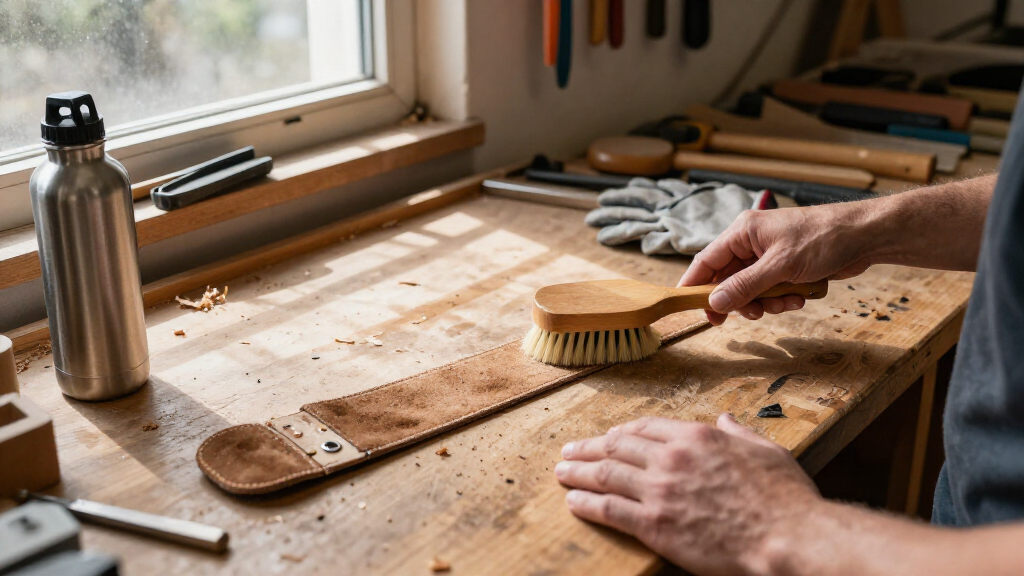
To clean everyday dust from a suede lifting belt, let it air out first and then brush the dry surface lightly in one direction with a clean suede brush or soft-bristled brush. This lifts the nap and loosens surface dirt without grinding particles into the leather. For a belt with a light dusting of chalk after squats, that gentle brush is often enough.
Start with the buckle and move across the belt in short, easy strokes. Don’t scrub back and forth as if you were sanding a board. Suede’s raised fibers can flatten under hard pressure, leaving a shiny patch that catches the light differently from the rest of the belt.
If grit is stuck in a small spot, stop and work slowly rather than bearing down. A suede eraser may help with some dry marks, but check the belt maker’s care instructions first and use it gently on a small area. The goal is to lift debris, not force a clean-looking finish at any cost.
Think of the nap like short grass: a light pass moves the surface fibers; a hard scrub mashes them down. Brushing is for dry surface dirt, not sweat, oil, or a deep stain. For those, first identify the mark and choose a method suited to the material.
Products Worth Considering

WORX Trivac WG588 40V Cordless 3-in-1 Leaf Blower, Vacuum, and Mulcher

Makita SP6000J 6-1/2-Inch Plunge Circular Saw

DEWALT 20V MAX Drill/Driver and Impact Driver Combo Kit (DCK240C2)
As an affiliate, we earn on qualifying purchases.
Dry sweat safely and keep sour odors from settling in
After a sweaty session, blot damp suede with a clean, dry cloth and let the belt air-dry completely in a well-ventilated place before storing it. Don’t rub the damp area, soak the leather, or use a washing machine. If your belt feels cool or clammy against your hand, give it more time.
For example, after a hot deadlift session, unbuckle the belt and hang it or lay it flat where air can move around it. A fan across the room can help circulate air, but keep the belt away from direct heat. Radiators, strong sun, and hair dryers can dry or warp leather, even when your aim is simply to speed things up.
Odor often gets worse when moisture stays trapped in a sealed gym bag. Give the belt a chance to breathe before you pack it away, and don’t try to cover a persistent smell with perfume. Fragrance adds another substance to the nap without removing the sweat that caused the smell.
Drying fully matters more than frequent wet cleaning. Moisture left in the leather can encourage odor and leave the belt uncomfortable or less predictable to handle; repeated wet cleaning adds its own risk by exposing the leather, stitching, and hardware to more water. How often you need to blot or brush depends on how often you train and how much you sweat. A brief airing after each workout is a sensible habit; a deep clean after every session is usually unnecessary.
Treat sweat marks and stains without flattening the suede
For a fresh sweat mark on a suede lifting belt, blot with a dry cloth, let the belt air-dry, and check the maker’s guidance before trying a cleaner. Fresh moisture calls for gentle blotting, not hard rubbing or a wet household-cleaning routine. Blotting removes surface moisture while limiting friction; rubbing can push it farther into the nap and flatten the fibers. A mark that remains after drying may need advice specific to the belt’s materials.
Once the belt is dry, you can try a clean suede brush or a suede eraser on a small area if the maker’s instructions allow it. Use light pressure and pause if the color changes or the nap starts to look uneven. A black belt may hide a faint mark better than a tan one, but both can show damage when fibers are rubbed flat. A small test helps reveal whether the method improves the mark or leaves a more visible patch before you treat a larger area.
Oil, ink, and large stains are harder to handle. Aggressive scrubbing can spread a mark or damage the surface, while household cleaners may leave their own residue. Trying stronger products might make a stubborn spot less noticeable, but it also raises the chance of changing the color or texture beyond that spot. If a stain is stubborn, consult the belt maker or a suede-care professional rather than experimenting over the whole belt.
There is no single cleaning schedule for every lifter. Someone who trains in a cool garage twice a week may only need occasional brushing, while a lifter training daily in a hot gym may need to air the belt after every session. More frequent airing responds to moisture without requiring more aggressive cleaning. Let the belt’s actual condition, your use, and its care instructions guide you.
Choose products that won’t grease or darken the nap
Use a cleaner or protector only if it is labeled as suitable for suede and compatible with your belt, and follow the belt maker’s directions. Test it on a small, hidden spot first. A spray that claims to resist water may still change the suede’s color or texture, so the test patch gives you a chance to spot a problem before treating the whole belt.
Skip general leather conditioners, oils, and waxes unless the manufacturer specifically approves them for that belt. Products intended for smooth leather can darken, grease, or flatten suede’s fuzzy surface. The difference matters: smooth leather has a different finish, while suede’s nap is part of what you’re trying to preserve.
Imagine treating a tan belt with a heavy conditioner after a few hard sessions. The color may turn darker where the product soaked in, and the rubbed areas can look slick instead of soft. That is a visible change you may not be able to brush away.
When in doubt, do less. Airing and gentle dry brushing handle ordinary upkeep; specialized products belong only on a problem they are meant to address. This keeps the routine low-risk, though it may not remove a deep stain or fully resolve a persistent odor. Follow product directions carefully, and don’t apply a spray near your eyes, open flames, or gym equipment in a way that ignores its label.
Store the belt so it stays dry, flat, and ready for your next session
Store a suede lifting belt in a cool, dry, ventilated place once it is fully dry. Lay it flat or roll it loosely, and avoid sharp folds that can crease the leather. Don’t leave it sealed in a damp gym bag or pressed under heavy equipment. The aim is to avoid prolonged dampness and pressure, both of which can leave the belt smelling stale or change its shape.
For instance, if you train before work, take the belt out of your bag when you get home and set it on a shelf with air around it. Leaving it zipped beside a wet towel traps moisture against the suede. Even if the belt feels dry on the outside, a cramped, damp space is a poor place to store it because the inner surface and seams may take longer to dry.
A loose roll can save space in a locker or gear bin, but don’t force the belt into a tight coil. The leather should rest without a hard bend or buckle pressing into the suede. Laying it flat takes more room, while loose rolling is a practical compromise if it avoids a sharp crease. If the belt is stiff from cold or storage, let it return to room temperature naturally instead of heating it.
Good storage is a small habit that can shorten avoidable wear from creases, dampness, and rough contact. Keep the belt away from leaking bottles, sharp tools, and anything that could gouge the surface. Then it is ready to cinch snugly for the next set, without a musty smell or a fresh crease to distract you.
Check the buckle and stitching before heavy lifts
Before using a suede lifting belt for heavy work, check that the leather, stitching, buckle, prongs, and rivets are intact and secure. Stop using it if damage could affect support. A belt’s job is to support your torso during heavy lifting; a loose stitch or cracked section can change how reliably it holds under load.
Take a few seconds before training to run your eyes along the seams and tug gently on the buckle when the belt is off your body. Look for frayed thread, a loose rivet, a bent prong, or a crack that opens when the leather flexes. A scuff on the nap may be cosmetic, but a seam separating near the buckle deserves attention.
For example, if a prong no longer sits securely or the belt’s stitching is pulling away, don’t test it with a heavy deadlift to see what happens. Contact the maker or a repair professional and have the belt assessed. Keep the load light or choose another sound belt until you know it can provide support.
Care can slow avoidable wear, but it cannot make damaged materials safe. Regular inspection helps you catch changes early, when a repair may still be practical. Appearance and function are different checks: a belt can look worn yet remain sound, or look tidy while a hidden seam is starting to fail.
Frequently Asked Questions
Can I get a suede lifting belt wet?
Try to keep it dry. If it gets damp, blot it gently with a clean, dry cloth and let it air-dry completely. Don’t wring it, soak it, or apply direct heat.
Can I use leather conditioner on suede?
Usually, no. Conditioners made for smooth leather can darken, grease, or flatten suede. Use a product only if it is labeled for suede and the belt maker’s instructions allow it.
How do I stop my belt from smelling?
Air it out after each session and let it dry fully before putting it away. Avoid perfume or soaking the belt to mask odor; if the smell persists, ask the maker or a suede-care professional for advice.
Can I wash a suede lifting belt in a washing machine?
No. Machine washing can damage the suede, leather structure, stitching, and hardware. Blot damp spots and air-dry the belt instead.
Should I use waterproofing spray on a suede lifting belt?
Only use a spray labeled for suede and compatible with your belt. Test a hidden area first, because a spray can change the color or texture.
Can I keep lifting with cracked leather or loose stitching?
Stop using the belt for heavy lifts if a crack, loose seam, or hardware problem could affect support. Have it assessed or repaired before putting it back under a heavy load.
Conclusion
Keep the routine plain: air the belt, blot sweat, brush dry dirt, and store it dry. Follow the maker’s care instructions before trying a cleaner or spray, and inspect the seams and hardware before heavy lifting.
A suede belt doesn’t need a complicated cleaning ritual; it needs room to breathe and a gentle hand. Treat it that way, and it can stay ready for the next set instead of marinating beside a damp towel.