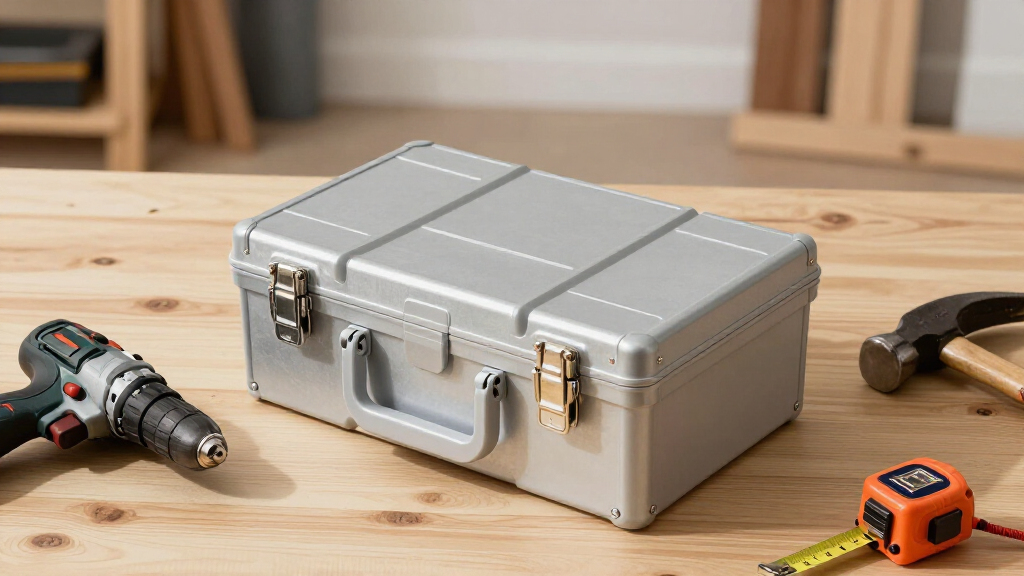

TL;DR
Open a free Amazon Business account
Business pricing, bulk buying and tax-exempt orders.
Create a free accountAs an affiliate, we earn on qualifying purchases.
Pick a storage box that matches your tools’ size and security needs. Consider construction, weather resistance, and portability. A well-chosen box keeps tools safe, organized, and ready for work.
Ever tried squeezing a long level or a few heavy power tools into a tiny toolbox? It’s frustrating. Picking the right job-site storage box isn’t just about size—it’s about durability, security, and how well it fits your work style.
When you’re on the clock, your tools need to stay safe from theft, weather, and damage. This guide cuts through the jargon and shows you exactly what to look for—so you can choose a box that works as hard as you do.
Match your storage box size to your biggest tools and daily needs—don’t overpay for empty space.
Prioritize thick steel (14-gauge or better) and welded seams for maximum security and weather resistance.
Secure your box with recessed locks, anchors, and heavy-duty materials to prevent theft.
Consider portability features like casters and forklift pockets if you need to move your tools frequently.
Weatherproof your box with gutter-style lids and gaskets if it sits outside year-round.
How to Choose a Job-Site Storage Box
Your box should fit your biggest tools, resist the risks on your site, and move the way your crew works. Use this guide to balance capacity, steel gauge, security, weather resistance, portability, and organization.
Match the box to your daily tool load and security risk. Thick welded steel protects best; gaskets protect outdoors; casters and lift points make heavy storage workable.
Six questions before you buy
The best box is not automatically the largest or heaviest. It is the smallest secure box that comfortably fits your working load and still moves through your real environment.
What must fit?
Measure the longest, tallest, and widest tool. Check internal dimensions—not just the advertised exterior or cubic-foot figure.
How exposed is it?
High-value tools or high-theft sites justify thicker steel, shielded locks, dual locking points, and permanent anchoring.
How often will it move?
Match smooth floors to locking casters, rough sites to forklift pockets, and truck use to secure mounting points.
Will it live outside?
Prioritize a gutter-style lid, full-length hinge, lid gasket, drainage, powder coat, and easily inspected seals.
Can you find tools fast?
Trays, shelves, bins, gas struts, and clear sight lines prevent the deep chest from becoming a “black hole.”
What does the site require?
Confirm general-contractor and insurance requirements for locks, anchoring, hazardous-material separation, and proof of reasonable security.
Buy for the tools, not the label
Standard widths form a useful ladder, but shape matters. Long levels, conduit benders, pipe, hoses, and saws can defeat a box with impressive volume but poor internal clearance.
Common width ladder
Material sets the tradeoff
Lower steel gauge means thicker metal. Welded seams, reinforced lids, and protected edges matter as much as the headline gauge when resisting prying, impact, and hard daily use.
16-gauge
A common balance for controlled sites and moderate tool values. Easier to move, but less resistant to concentrated prying than thicker steel.
14-gauge
Thicker, heavier, and more pry-resistant. Best paired with fully welded seams, anti-pry lips, a reinforced lid, and secure anchoring.
Polymer
Rust-proof and easier to carry. Well suited to modular stacks and lower-risk work, but not equivalent to a welded steel chest for forced-entry resistance.
A lock is only the first layer
Think like a thief: protect the shackle, prevent lid prying, stop the entire box from being carried away, and make valuable assets traceable.
Shield the lock
Choose a recessed padlock housing, tamper-resistant hasp, or shackle-less puck lock that limits access for bolt cutters.
Reinforce the lid
Anti-pry lips, internal lock rods, dual locking points, and reinforced supports make leverage attacks more difficult.
Anchor the body
Bolt the chest to a slab or truck bed. A heavy box discourages carry-away theft; an anchored heavy box is stronger still.
Add visibility
For high-risk sites, consider hidden GPS trackers, connected locks, inventory tags, alarms, or nearby surveillance.
Insurance checkpoint: Some policies and job sites require lockable, anchored storage or other reasonable security measures. Confirm the exact standard before purchasing.
Turn requirements into a decision
Follow this chain in order. It prevents a single attractive feature—such as wheels or sheer volume—from hiding a poor fit elsewhere.
Inventory
List daily tools, awkward shapes, and total replacement value.
Measure
Check internal fit plus doors, gates, truck beds, and access routes.
Rate risk
Score theft exposure, weather, impacts, and site restrictions.
Plan movement
Select casters, forklift pockets, lift eyes, or fixed anchoring.
Verify
Confirm locks, seals, seams, organization, warranty, and compliance.
Choose the storage strategy
Many crews now combine a fixed steel chest with a modular rolling stack: bulk security stays on site while selected tools travel to the task.
| Format | Best use | Security | Mobility | Weather | Watch for |
|---|---|---|---|---|---|
| Polymer modular stack | Solo trades, service calls, frequent movement | Limited pry resistance and smaller modules | |||
| 16-gauge chest | General daily storage on controlled sites | Lock housing, seam quality, caster rating | |||
| 14-gauge gang box | Crews, valuable tools, high-risk locations | Weight, access route, loading equipment, price | |||
| Piano-style box | Large-volume truck or crew storage | Deep reach, footprint, internal organization | |||
| Hybrid setup | Secure base storage plus task-level mobility | Duplicate organization and system compatibility |
The job-site box checklist
Inspect the actual model whenever possible. Open it, reach into every corner, test the lid, examine the seams, and picture the box fully loaded—not empty on a showroom floor.
Internal fit: biggest tools clear the lid, trays, and lock mechanism.
Construction: 14- or 16-gauge steel, welded seams, reinforced edges.
Security: recessed lock, anti-pry lip, anchor points, protected hardware.
Weather: gutter lid, gasket, piano hinge, drainage, durable finish.
Movement: rated locking casters, forklift pockets, or secure lift points.
Usability: trays, bins, shelves, gas struts, and clear sight lines.
Maintenance: inspect scratches, hinges, drainage, locks, and seals regularly.
Compliance: verify site, insurer, truck-mounting, and material rules.
The winning box fits your largest tool, your real risk, and your daily route—with no critical compromise.
Fit × Protect × MoveHow to Pick the Perfect Size for Your Tools
The first thing to ask: How much space do I need? Size and capacity are measured in cubic feet. For example, a 48″ x 24″ x 24″ chest offers roughly 25 cubic feet of storage—plenty for most trades.
Think about what you carry daily. Electricians might need room for long conduit benders and multi-meters, while plumbers look for space for pipe wrenches and hoses. Match capacity to your typical load. Measure your biggest tools—will they fit comfortably?
Also, consider the site. Will the box fit in your truck bed, or do you need a portable unit that can pass through a standard door? Remember, internal dimensions matter more than external. A box labeled 50 cubic feet might be slightly smaller inside due to thick walls.
As an affiliate, we earn on qualifying purchases.
Why Durability and Material Matter
Durability isn’t just about looking tough—it’s about standing up to real work. Steel is the gold standard. 16-gauge steel is common; 14-gauge is thicker, tougher, and more pry-resistant.
Imagine a crew on a muddy site. A fully welded, powder-coated steel box resists rust, dents, and forced entry better than a lighter plastic or thinner metal. For outdoor jobs, weather-resistant finishes and gutter-style lids that shed rain make a big difference.
Choosing the right material affects not just how long your box lasts but also how secure your tools are. Thicker steel means more resistance to theft and weather damage, reducing replacement costs and downtime. Conversely, lighter materials might be easier to transport but often require more careful handling and may not withstand harsh conditions as well.
Tradeoffs exist: heavier steel boxes offer better security and durability but can be more cumbersome to move, especially if you need to relocate frequently. Lighter plastics or thinner metals are easier to handle but may compromise on security and longevity in tough environments. Your choice depends on balancing these factors based on how and where you’ll use the box.
As an affiliate, we earn on qualifying purchases.
How to Keep Your Tools Safe: Locking & Security Tips
Security is king. A lockable box deters theft—especially when tools cost thousands and theft rates are climbing. Look for recessed padlock housings and tamper-resistant hasps that shield shackles from bolt cutters.
Recessed locks are a smart choice—they make it harder for thieves to cut or pry. Reinforced lids, anti-pry lips, and the ability to anchor the box to the site or truck bed add layers of protection.
For maximum security, consider puck locks or dual-locking systems. Remember, a heavier, bolted-down box resists casual theft better than a lightweight, portable one.
Understanding the security features isn’t just about theft prevention; it can also impact your insurance coverage. Many policies require specific lock and anchoring standards to qualify for claims, so investing in these features can save money in the long run.
Beyond the lock itself, think about your environment. If you’re working in a high-theft area or storing very valuable tools, investing in additional security measures like alarm systems or surveillance can be worthwhile. Conversely, if theft isn’t a big concern, a basic lock and anchor might suffice. The key is understanding your risk and choosing appropriate security features accordingly.
portable job site storage box with casters
As an affiliate, we earn on qualifying purchases.
As an affiliate, we earn on qualifying purchases.
Making Portability Work for You
Portability isn’t just about wheels. Heavy-duty casters, forklift skids, and crane lift points matter. A fully loaded 48″ steel chest can tip the scales over 300 pounds—hard for one person to move.
Premium casters with locking brakes work well on smooth surfaces, but gravel or mud can wear them out fast. For frequent moves, removable casters or handles can make your life easier.
Pre-drilled mounting points or forklift pockets turn a heavy box into a portable beast—ideal for moving around the site or loading into trucks.
Think about your daily routine. Do you need to wheel your tools across uneven terrain or lift them with a forklift? Choose accordingly.
Balancing portability with durability means considering how often you’ll move your storage and under what conditions. Heavy-duty features typically add cost but can save time and effort on busy job sites.
Keep in mind that adding features like casters or forklift pockets may slightly reduce the internal storage space or add to the overall weight. Weigh these tradeoffs against your specific needs to find the best solution for your workflow.
security lockable tool storage box
As an affiliate, we earn on qualifying purchases.
As an affiliate, we earn on qualifying purchases.
Weatherproofing Your Job-Site Box
If your box lives outside, rain, snow, and humidity are enemies. Full-length piano hinges, gutter-style lids, and weather stripping help keep water out.
Imagine a sudden downpour. A box with a gutter lid and sealed gaskets sheds rain, keeping your tools dry and rust-free. Drainage holes are vital if water does get inside—no one wants a soggy socket set.
For outdoor storage, select boxes with rust-resistant finishes and consider adding a tarp or cover for extra protection.
Weatherproofing isn’t just about water—UV resistance and scratch-proof finishes prolong your box’s life in the sun. These features prevent premature aging, fading, and cracking, which can compromise the box’s integrity over time.
Choosing weather-resistant features means your tools stay protected longer, reducing replacement costs and downtime, especially in climates with frequent rain or snow. Remember, no matter how weatherproof your box is, regular maintenance—like cleaning and inspecting seals—extends its lifespan and keeps it performing at its best.
Organizing Inside: Trays, Bins, and Visibility
A cluttered box slows you down. Removable trays, interior bins, and shelves turn chaos into order. Tall lids or gas struts give you easy access to taller tools—no more digging in the dark.
Look for clear sight lines or transparent bins. Knowing exactly where that hammer or bit set is saves time and frustration.
For example, a mechanic’s toolbox with removable trays lets him quickly grab screwdrivers and wrenches without rummaging through a deep, dark compartment.
Prioritize features that make tools easy to find—your efficiency depends on it. Well-organized interiors also reduce the risk of damaging delicate tools or losing small parts, which can lead to costly replacements or delays.
Consider the types of tools you carry. Larger, deeper compartments might be suitable for power tools, while small bins are better for fasteners and small parts. Customizable interior layouts can help optimize space and accessibility, ensuring your tools are organized in a way that matches your workflow.
Meeting Site & Insurance Standards
Some sites demand lockable, anchored storage. Check your insurance policy—most require secure, tamper-proof boxes to cover theft or damage.
Anchoring to the floor or truck bed prevents thieves from just grabbing and running. OSHA and insurance providers often specify lockable, weatherproof, and tamper-resistant features.
For example, a contractor with a theft claim found that a simple anchored, lockable steel box saved her thousands in losses and kept her insurance coverage intact.
Double-check local regulations and your insurer’s requirements before investing in your storage solution.
Failing to meet site or insurance standards can result in denied claims or legal issues, which can be costly. Properly securing and anchoring your box ensures compliance and peace of mind.
Remember, standards vary by location and project type. Always verify specific requirements with your site manager or insurer to avoid surprises and ensure your storage solutions are compliant and protected.
Quick Checklist: What to Look for in a Job-Site Box
| Feature | Why It Matters |
|---|---|
| Size & capacity | Fits your tools & site space |
| Material & gauge | Durability & security |
| Locking options | Prevents theft & complies with site rules |
| Portability features | Easy to move & position |
| Weather resistance | Protects tools outside |
Frequently Asked Questions
What size job-site box do I need for my trade?
Measure your biggest tools and daily load. For electricians, a 48″ x 24″ x 24″ chest offers around 25 cu ft, enough for most hand and power tools. Plumbers might prefer a slightly wider or taller box for pipes and hoses. Match capacity to your typical tools—don’t buy bigger than you need.
Is 16-gauge steel enough, or should I pay for 14-gauge?
For maximum security and weather resistance, 14-gauge steel is better. It’s thicker, more pry-resistant, and stands up longer outdoors. If your tools are high-value or you work in rough conditions, spend the extra on heavier gauge steel.
How do I secure my job-site box so it can’t be carried off?
Anchor the box to the floor, truck bed, or concrete slab using heavy-duty bolts. Use a lockable lid with recessed locks or puck locks. For added security, choose a heavier, steel box that’s difficult to lift or pry open. Combining these measures makes theft much less likely.
Can a job-site box stay outside in rain and snow?
Yes, but choose one with weatherproof features: gutter-style lids, gaskets, and rust-resistant finishes. For extra protection, keep the box under a tarp or cover. Drainage holes prevent water buildup inside, and regular maintenance—like cleaning and inspecting seals—extends its lifespan and keeps it performing at its best.
Conclusion
Choosing the right job-site storage box isn’t about the biggest or most expensive. It’s about finding a balance—size that fits your tools, durability that lasts through rain and rough handling, and security that keeps thieves at bay.
Invest wisely, and your tools will stay safe, organized, and ready for the next job—no matter how tough the site gets.
Labor Day sales Picks
labor day deals
As an affiliate, we earn on qualifying purchases.