
TL;DR

Get business pricing on tools and workshop supplies
- Business-only prices and quantity discounts
- Tax-exempt purchasing
- Multiple users, one account, clear invoices
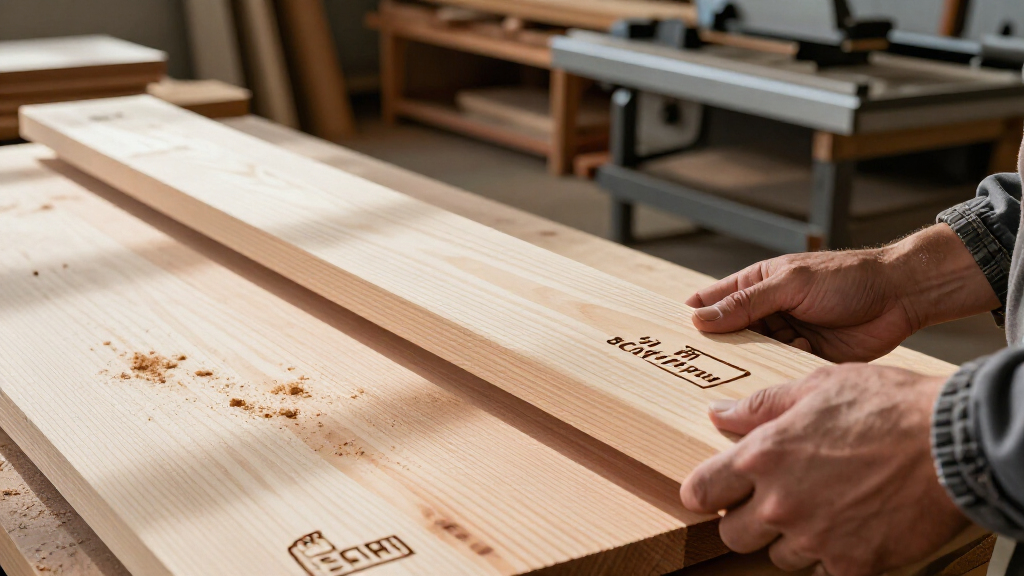
A stamp on framing lumber records the mill, grading agency, grade, species and, on many boards, moisture condition when the wood was surfaced. Those details connect a board to published design values and code span tables; the price tag and visual appearance alone cannot establish whether it is suitable for a particular structural job.
A grade stamp on framing lumber identifies the board’s grade, species, mill and grading agency, information that helps determine whether it is rated for a particular structural use. A report by Family Handyman says shoppers who choose boards mainly by price or appearance can miss details that connect lumber to published design values and building-code span tables.
The stamp is generally printed in black ink near one end of framing boards such as 2-by-4s and 2-by-6s. Its fields identify the mill, the agency overseeing grading, the board’s grade and species, and often the wood’s moisture condition when it was surfaced. The exact layout can vary by agency, but the information serves the same broad purpose: identifying the product and the grading rules applied to it.
The grade and species are key to published design values, which describe properties used in structural calculations. Those values feed span tables: code charts that show how far a joist or rafter of a given size, species, grade and spacing can extend between supports. The report says the 2024 International Residential Code requires sawn lumber used for load-supporting floor, wall and roof framing to carry a grade stamp or a certificate of inspection.
A stamp is not a promise that every board in a store bin is flawless or meets its grade. Paul Conway, executive vice president of the American Lumber Standard Committee (ALSC), wrote that mills are checked by shipping unit and a unit is considered on grade when at least 95% of its pieces meet the grade. The report also cites the USDA Forest Products Laboratory’s Wood Handbook: published bending values are based on strength near the lower end of a grade and then reduced for safety and long-term loading.
How the Stamp Affects Structural Use
For a buyer selecting lumber for a structural project, the stamp provides information that a price label or quick visual check cannot. A board’s suitability depends on the grade, species, size and spacing used in the relevant design or span table—not simply on whether it looks straight or has few visible defects. A stamp can help a buyer identify which published values apply, but it does not by itself establish that a board is right for every project.
The grade reflects how features such as knots, splits and holes affect a board’s strength under the applicable grading rules. That makes grade different from a purely cosmetic judgment. The report recounts lumber grader Pete Austin describing a customer who rejected five boards for wane—bark or missing wood along an edge—then selected five replacements that were all below grade. The anecdote illustrates why appearance alone can mislead; it is not evidence that shoppers generally choose the wrong boards at any particular rate.
For homeowners and builders, reading the stamp can support better questions at the lumber rack: What species is this? Which grade applies? Is this the grade specified for the intended use? For structural work, calculations and code requirements still govern. The stamp is a traceable label and a link to standardized values, not a substitute for a plan, code review or qualified professional’s judgment.
As an affiliate, we earn on qualifying purchases.
Five Fields Behind the Ink
The report describes five main fields on an accredited grade stamp. The mill number or name identifies where the board was made and can help trace a product if a problem affects a batch. The grading-agency mark identifies the organization that supervised grading; it is not simply the mill’s own logo. The report notes that an unfamiliar mark can be checked against the ALSC’s published list of accredited agencies.
The grade states the classification assigned under the applicable rules, while the species or species group identifies the wood category used with that grade to determine design values. A surfacing or moisture notation may also appear. The source explains that this records how wet the lumber was when it was planed to its final dimensions, offering a clue about how much drying and shrinkage may remain after installation. It does not give a precise prediction of how much an individual board will shrink.
Grading is conducted under standardized rules, but the report emphasizes that wood is a natural material and individual boards vary. According to Conway, agencies inspect mills at least 12 times a year under ALSC requirements, and the federal lumber standard PS 20 sets rules for the system. The source identifies agencies including the Western Wood Products Association, the Pacific Lumber Inspection Bureau, the Southern Pine Inspection Bureau and the Northeastern Lumber Manufacturers Association. Canadian grading agencies use their own marks under Canadian rules.
““I don’t think that they fully understand what it is they’re buying.””
— Pete Austin, director of quality at the Western Wood Products Association
As an affiliate, we earn on qualifying purchases.
What a Stamp Cannot Guarantee
The source does not identify a specific new regulation, product recall or change to lumber grading. It is a consumer report explaining how existing stamp fields work. Its reference to the 2024 International Residential Code concerns that code’s requirement for load-supporting sawn lumber; requirements adopted and enforced can depend on the jurisdiction and the project.
A grade stamp also cannot show from the label alone whether a particular board is free of damage incurred after grading, or whether it suits a specific design. Conway’s explanation that a unit may be on grade even though some individual pieces are not makes clear that the system is not a board-by-board guarantee. The report does not quantify how often shoppers misread stamps or how much shrinkage a particular board will experience.
For unfamiliar grading marks, the source advises checking the logo against the ALSC list. A stamp that is not from an accredited agency does not count as an accredited grade stamp under the report’s explanation. Readers should also confirm local code requirements and the lumber specifications for their project rather than infer structural suitability from appearance or a single label field.
As an affiliate, we earn on qualifying purchases.
Check the Grade Before Building
At the lumber rack, readers can inspect the full stamp rather than stopping at the price or grade. Confirm the species and grade required for the project, note any moisture or surfacing information, and check an unfamiliar grading-agency mark against the current ALSC list. If the label is missing or unclear, ask the retailer for documentation or select lumber with legible grading information appropriate to the intended use.
For a load-supporting project, the next step is to compare the board’s size, species and grade with the project’s plans and applicable span tables. Where the structural requirements are uncertain, consult a qualified building professional or the local building department. The report describes the stamp as a source of standardized product information; it does not announce a further regulatory decision or a scheduled change to grading rules.
building code span table reference
As an affiliate, we earn on qualifying purchases.
As an affiliate, we earn on qualifying purchases.
Key Questions
What does a lumber grade stamp tell me?
It identifies the mill, grading agency, grade and species, and may state the wood’s moisture condition when surfaced. Grade and species are used with lumber dimensions and spacing to find applicable published design values and span-table information.
Does a grade stamp guarantee every board meets its grade?
No. Paul Conway of the ALSC said mills are inspected by shipping unit, and a unit is considered on grade when at least 95% of its pieces meet the grade. The stamp is not a guarantee that each individual board in a retailer’s bin is on grade.
Does the grade tell me whether a board is right for my project?
Not by itself. The applicable structural rating depends on details including grade, species, dimensions and spacing, as well as the project design and local code requirements. Use the relevant plans and span tables, and seek qualified advice if the requirements are uncertain.
What should I do if I do not recognize the grading logo?
Check it against the ALSC list of accredited grading agencies, which the report says includes agency marks. If the mark cannot be verified or the stamp is missing, ask the retailer for documentation rather than assuming the board has an accredited structural grade.
Source: rss
Halloween Picks
halloween
As an affiliate, we earn on qualifying purchases.