TL;DR

Get business pricing on tools and workshop supplies
- Business-only prices and quantity discounts
- Tax-exempt purchasing
- Multiple users, one account, clear invoices
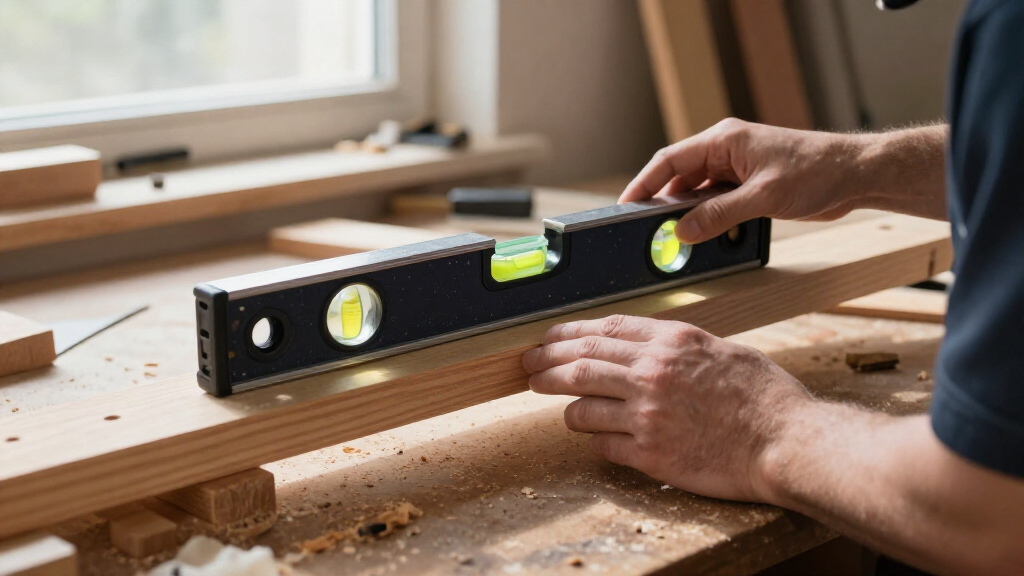
A Family Handyman report explains that level size can affect how reliably a surface is checked: short tools may miss uneven areas, while long ones can be awkward in tight spaces. It recommends choosing a level that sits steadily, checking multiple spots when the tool is shorter than the surface, and keeping both contact surfaces clean.
Level size and placement can affect a project’s accuracy, according to a Family Handyman report explaining how to match the tool to the surface being checked. A level that is too short may fail to reveal unevenness near the ends of a board, while an overly long tool can be difficult to position in a confined space.
The report says there is no fixed rule for how much of a surface a level must cover. The tool should fit comfortably and make enough contact to sit securely. For a surface longer than the level, the user can take readings at several points along its length rather than relying on one position. The report gives a 24-inch level on a four-foot shelf as an example.
It describes 6- to 12-inch levels, often called torpedo levels, as useful in cabinets, around pipes and other tight spaces. A 24-inch level suits many household tasks, including shelves and smaller cabinets; a 48-inch model can check longer boards, countertops and framing. Levels of 72 inches or more are suited to larger work, such as tall door frames and walls, but may be unwieldy in small rooms.
Before taking a reading, the report advises cleaning away sawdust and dirt from the level and the material. The tool should sit firmly and should not rock. Some overhang beyond an edge is acceptable if the level remains stable; if it tips or rocks, a shorter tool may be more suitable.
How Level Length Affects Readings
Choosing a suitable level can help prevent a project from being judged by an incomplete or unstable reading. A short tool may show that one section is level while failing to reveal a dip or rise farther along the material. That matters for work such as shelves, counters and framing, where alignment across more than one point can affect the finished result.
Using the longest tool available is not automatically the answer. In a narrow cabinet or around plumbing, a long level may be difficult to place flat and steady. The practical test is whether the tool has stable contact with the surface and can be used in a way that checks the relevant area. Repeated checks with a shorter level, or a longer straight board used as a reference, can cover more ground when a full-length level will not fit.
The report offers general guidance, not a guarantee that any particular level will produce a reliable result on every material. Surface condition, tool stability and the way readings are taken all matter alongside length.
Products Worth Considering

WORX WG461 Cordless 40V Snow Blower, 20-Inch

DEWALT 20V MAX 5-Inch Brushless Cordless Random Orbital Sander Kit (DCW210D1)

EGO Power+ HT2601 26-Inch Cordless Hedge Trimmer with 56V 2.5Ah Battery and Charger
As an affiliate, we earn on qualifying purchases.
Level Sizes for Household Jobs
The report draws on guidance from tool references including Johnson Level & Tool, STABILA and The Home Depot. The Home Depot advises using a four-foot carpenter’s level for framing when there is room, saying that warps or waves in boards can throw off a shorter level. That guidance supports using more length for framing, but does not mean a level must span every surface in every task.
For longer surfaces that cannot be checked conveniently with one level, the Family Handyman report suggests placing a smaller level on a long, straight board to check a wider area. It also identifies a laser level as an option for lining up points across a room. The appropriate choice depends on the task and the space available; the report does not prescribe one tool for all projects.
“Use a 4-foot carpenter’s level for framing whenever you have room for its length.”
— The Home Depot, as quoted in the Family Handyman report
Limits of the Sizing Guidance
The source gives general size ranges, not a formal standard specifying how much of each surface a level must cover. It also does not provide a testing method or measurements comparing the accuracy of different level lengths. The report’s advice is to check multiple positions when using a shorter level and to make sure the tool sits steadily.
It does not identify a specific model or explain how to verify that a level itself is calibrated. Readers should not take the size recommendations as a substitute for checking the tool and the material, especially when a project has requirements beyond ordinary household alignment. The source also does not quantify how much error dust, dirt or rocking might introduce.
Check the Tool Before Starting
The report offers no scheduled follow-up or announced product change. For a project in progress, its practical guidance is to choose a level that fits the space, clean the tool’s contact surface and the material, and confirm that the level rests without rocking. If the level is shorter than the workpiece, take readings at several positions rather than treating one reading as representative of the whole surface.
For work across a larger area, consider whether a longer level, a straight reference board or a laser level fits the task. If an overhanging level tips or shifts, switch to a tool that can be supported steadily.
Key Questions
Does a level have to span the entire surface?
No. The report says a shorter level can be used on a longer surface if readings are taken at several points. A 24-inch level on a four-foot shelf is one example.
What level size works for common household projects?
The report describes a 24-inch level as useful for tasks such as hanging shelves and installing smaller cabinets. The best choice also depends on available space and whether the tool can sit steadily.
Can a level hang over the edge?
Some overhang is acceptable if the level has enough support to remain stable. If it tips or rocks, the report recommends using a shorter level.
Why clean the level and the surface first?
Sawdust or dirt beneath the tool can affect how it sits and may change the reading. The report advises cleaning both contact surfaces and checking that the level does not rock.
What can I use to check a long surface?
Options in the report include checking multiple spots with a shorter level, placing it on a long, straight board, or using a laser level to line up points across a room.
Source: familyhandyman.com