
TL;DR

Get business pricing on tools and workshop supplies
- Business-only prices and quantity discounts
- Tax-exempt purchasing
- Multiple users, one account, clear invoices
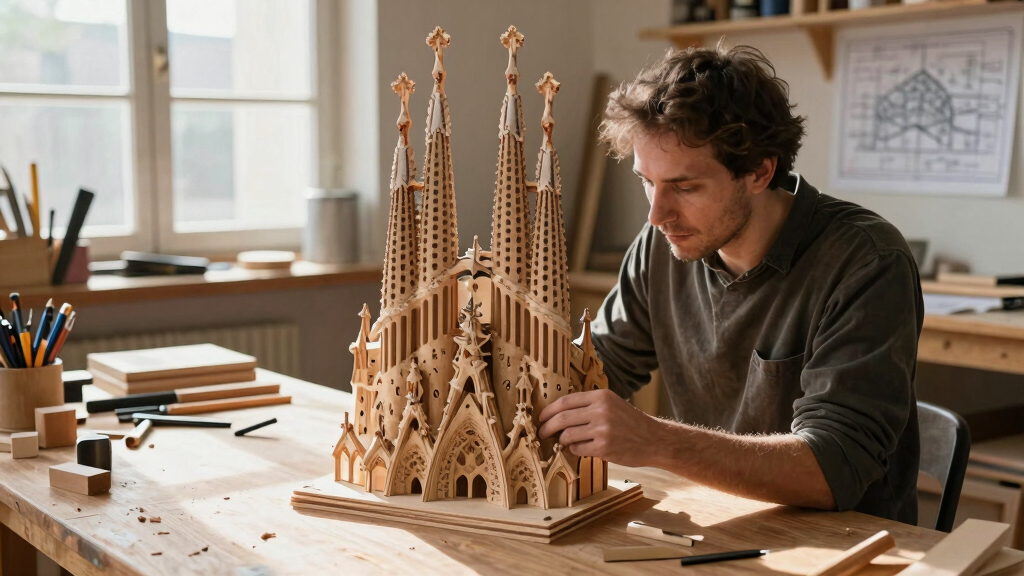
Recent studies have uncovered intricate mathematical patterns in the design of Barcelona’s Sagrada Familia. Experts confirm that Gaudí employed advanced geometry and proportions, revealing the basilica’s hidden mathematical structure. This discovery deepens understanding of Gaudí’s architectural genius and the basilica’s ongoing construction challenges.
Recent scholarly analysis has confirmed that the Sagrada Familia incorporates intricate mathematical patterns, including advanced geometric proportions and fractal-like structures, designed by architect Antoni Gaudí. This discovery sheds light on the basilica’s complex architecture and underscores Gaudí’s use of mathematics to achieve structural stability and aesthetic harmony.
Researchers from the University of Barcelona analyzed detailed architectural data and digital models of the Sagrada Familia, revealing that Gaudí employed specific mathematical principles, such as the use of the Fibonacci sequence, golden ratios, and complex geometric forms like catenary arches and hyperboloids. These elements contribute to the basilica’s unique aesthetic and structural integrity.
According to Dr. Maria López, lead researcher, ‘Gaudí’s work was not only artistic but also deeply rooted in mathematical concepts that ensured the stability and beauty of the structure.’ The findings confirm that Gaudí’s design was guided by a sophisticated understanding of geometry, predating modern computational methods.
Construction of the basilica began in 1882 and remains ongoing, with these mathematical insights potentially influencing current and future building techniques. Experts believe that understanding Gaudí’s mathematical approach could aid in the basilica’s completion, expected in the coming decade.
Why Discovering Gaudí’s Mathematical Approach Matters
This revelation highlights the innovative nature of Gaudí’s architecture, demonstrating that his designs integrated complex mathematics long before the advent of modern computational tools. It enhances appreciation for his genius and could influence contemporary architectural practices, especially in projects requiring complex geometries.
Furthermore, understanding these mathematical principles may assist engineers and architects involved in the basilica’s ongoing construction, potentially improving structural safety and efficiency. The findings also elevate the cultural and scientific value of the Sagrada Familia as a masterpiece of architectural innovation.
geometric design tools for architects
As an affiliate, we earn on qualifying purchases.
As an affiliate, we earn on qualifying purchases.
Historical and Technical Background of Sagrada Familia’s Design
Construction of the Sagrada Familia was initiated by Gaudí in 1882, and it has become one of the most iconic landmarks in Barcelona. Gaudí’s architectural style combined Gothic and Art Nouveau elements, but recent research suggests that his work was also driven by an underlying mathematical framework. Previous studies have focused on Gaudí’s use of natural forms and organic shapes, but the new findings reveal a deeper layer of mathematical sophistication.
Modern digital modeling and analysis techniques have enabled researchers to decode the geometric complexity of Gaudí’s design, confirming that his work was guided by principles such as the Fibonacci sequence, golden ratios, and hyperbolic geometries. This aligns with Gaudí’s known fascination with natural forms and mathematical harmony.
“Gaudí’s use of mathematics was integral to both the aesthetic and structural aspects of the basilica, long before modern computational tools.”
— Dr. Maria López
As an affiliate, we earn on qualifying purchases.
What Aspects of Gaudí’s Mathematical Methods Are Still Unclear
While researchers have identified key mathematical patterns, it remains unclear how much of Gaudí’s full methodology was documented or consciously applied. It is also uncertain whether these principles were explicitly intended or emerged from his intuitive design process. Additionally, the impact of these findings on current construction techniques is still being evaluated, and some aspects of Gaudí’s use of mathematics are subject to ongoing analysis.
Fibonacci sequence architecture book
As an affiliate, we earn on qualifying purchases.
As an affiliate, we earn on qualifying purchases.
Future Research and Application of Mathematical Insights in Construction
Researchers plan to further analyze Gaudí’s sketches and models to uncover additional mathematical principles. Structural engineers involved in the basilica’s construction are considering how these insights might optimize ongoing building efforts, possibly influencing techniques for the remaining sections. The findings could also inspire new architectural designs that leverage similar mathematical frameworks.
In the coming years, experts aim to develop detailed guides for applying Gaudí’s mathematical approach in modern architecture, potentially setting new standards for designing complex, stable structures.
As an affiliate, we earn on qualifying purchases.
Key Questions
How did researchers uncover the mathematical secrets of Sagrada Familia?
Using digital modeling, geometric analysis, and comparison with Gaudí’s sketches, researchers identified patterns such as Fibonacci sequences and hyperbolic forms within the basilica’s design.
Why is Gaudí’s use of mathematics significant?
It demonstrates that Gaudí integrated advanced geometric principles into his architecture, predating modern computational methods, which contributed to the structure’s stability and aesthetic harmony.
Will this discovery affect the basilica’s ongoing construction?
Potentially, yes. Understanding Gaudí’s mathematical approach may help optimize structural design and construction techniques as the basilica nears completion.
Are all of Gaudí’s mathematical methods now known?
No, some aspects remain under investigation. Researchers continue to analyze his sketches and models to uncover additional principles.
Could these findings influence future architectural designs?
Yes, architects may incorporate similar geometric and mathematical principles inspired by Gaudí to create innovative, structurally sound designs.
Source: hn
Fall Picks
fall essentials
As an affiliate, we earn on qualifying purchases.