
TL;DR

Get business pricing on tools and workshop supplies
- Business-only prices and quantity discounts
- Tax-exempt purchasing
- Multiple users, one account, clear invoices
A Hunker report identifies wet or overgrown grass as a major limitation for mulching mowers. Clippings can build up under the deck and on the blades, strain the motor and leave clumps on the lawn; the report cites Illinois Extension guidance not to remove more than one-third of the grass height at once.
A Hunker report identifies a key limitation of mulching mowers: they can struggle with wet or overgrown grass, allowing clippings to clump under the mower deck or on the blades. That buildup can reduce cutting efficiency, put extra strain on the motor and leave wet clumps on turf, where they may block sunlight and airflow.
Mulching mowers cut grass into small pieces intended to fall back into the lawn and decompose, rather than collecting or discharging longer clippings. But the Hunker report says that cutting system is not well suited to grass that needs a large amount of its height removed. Citing Illinois Extension, it gives a rule of thumb: avoid removing more than one-third of the grass height in a single mowing.
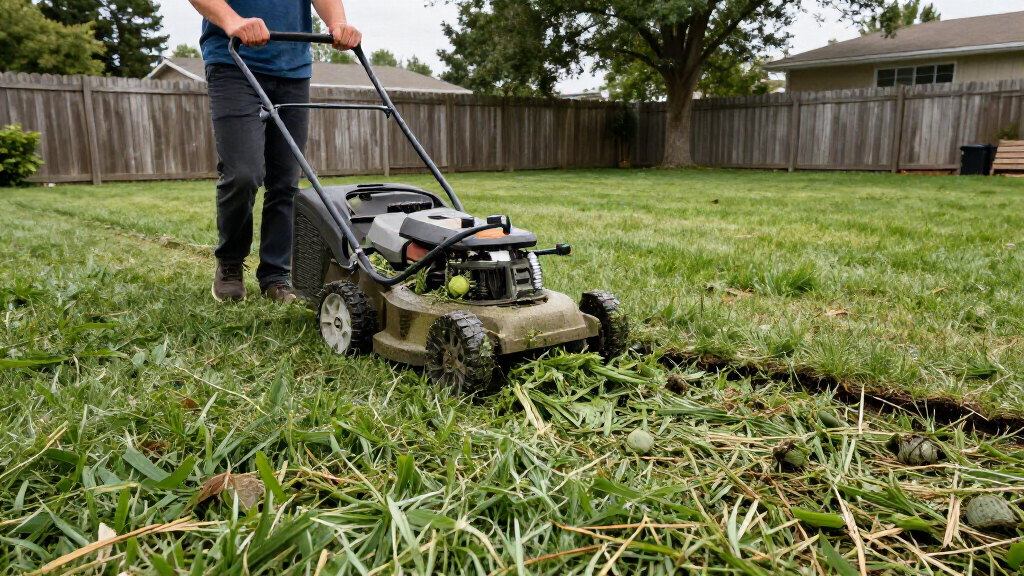
Wet grass presents a separate problem. According to the report, moisture can make clippings stick to the mower’s curved blades, which are designed to cut the grass repeatedly into smaller pieces. When the clippings clump instead, they may accumulate on the blades and elsewhere in the mower, including under the deck. The report says this can impede airflow needed for mulching and reduce the mower’s efficiency.
The buildup may also make the mower work harder. Hunker says clumps can strain the motor and that a mower shutting down while being used on wet grass could have grass buildup as a possible cause. The report does not establish that clogs are the cause in every case, or that every mower will be damaged. It also notes that both dedicated mulching mowers and conventional mowers fitted with a mulching kit face similar limitations.
When Clippings Can Harm Turf
The limitation matters because mulching is often used to return finely cut grass to the lawn, but clumps left on the surface are different from evenly dispersed small clippings. Hunker warns that wet clumps can block light and airflow, potentially suffocating healthy turf. A mower intended to support lawn maintenance may therefore leave an uneven result if conditions are unsuitable.
There are also practical costs. A clogged deck or blade can interrupt mowing and reduce performance; repeated strain may affect the equipment. The report does not quantify the likelihood or repair cost of damage, but its guidance points to a straightforward way to reduce the risk: avoid mulching when the grass is wet or so tall that the mower would need to cut off more than one-third of its height.
For readers, the distinction is between the mower’s intended use and the conditions in which it is operating. Small clippings can decompose in the turf, but that benefit depends on the mower being able to cut and spread them effectively.
Products Worth Considering

WORX 20V Cordless Oscillating Multi-Tool WX698L

Milwaukee M18 FUEL 8-1/4-Inch Brushless Table Saw Kit (2736-21HD)

Bosch GTS18V-08N14 PROFACTOR 18V 8-1/4-Inch Portable Table Saw Kit with 8 Ah Battery
As an affiliate, we earn on qualifying purchases.
How Mulching Differs From Bagging
A mulching mower uses its cutting system to chop grass into smaller pieces and return them to the lawn. The Hunker report contrasts this with traditional rotary mowing, where longer clippings may remain on top of the turf or be collected, depending on the mower setup. Mulching can be useful when the grass is at a manageable height and dry enough to cut cleanly.
The report’s caution applies whether the mower is built for mulching or uses a mulching kit. It also stresses that clipping size and distribution can vary with mower size and design, citing Illinois Extension. That means the label “mulching mower” alone does not guarantee that clippings will be evenly dispersed or that the lawn will remain healthy.
“A mulching mower will not perform well if you need to remove more than one-third of the height of your grass due to overgrowth.”
— Illinois Extension, as cited by Hunker
What Varies by Lawn and Mower
The supplied report does not specify a publication date, test results, or a rate at which wet-grass clogs lead to motor damage. It describes potential effects rather than a guaranteed outcome. The extent of clumping and the way clippings spread can vary with mower size and design, according to the Illinois Extension guidance cited by Hunker.
It is also not possible to diagnose yellow or brown patches from the report alone. Hunker says those symptoms, along with wilting or compacted soil, can signal turf stress, but they may have causes beyond mowing, including poor soil aeration or nutrient deficiencies. The report does not establish how often each cause occurs or provide a lawn-specific diagnosis.
Check Conditions Before Mowing
The practical next step is to check whether the lawn is dry and whether the mower can cut it without removing more than one-third of the grass height. If the grass is wet or substantially overgrown, the report’s guidance is to avoid using the mulching setting in those conditions. If the lawn is cut and clumps remain, clearing buildup from the mower and observing whether the turf recovers may help distinguish a mowing problem from other lawn issues.
Readers seeing persistent yellow or brown patches, wilting or compacted soil should not assume the mower is the sole cause. The Hunker report points to possible soil aeration and nutrient issues as other explanations, but offers no diagnosis or follow-up findings. No further test, product notice or official action is identified in the supplied material.
Key Questions
What is the main drawback of a mulching mower?
It can struggle with wet or overgrown grass. Clippings may clump on the blades or under the deck instead of being chopped and spread evenly.
How much grass should a mulching mower cut at once?
Illinois Extension guidance cited by Hunker says a mulching mower will not perform well when it must remove more than one-third of the grass height in one pass.
Why is mowing wet grass a problem?
Wet clippings can stick to the blades and collect under the deck. That can reduce airflow and cutting efficiency, strain the motor and leave clumps on the lawn.
Can lawn discoloration be blamed on mulching?
Not from discoloration alone. Hunker lists wilting and yellow or brown spots as signs of possible turf stress, while also noting other potential causes such as poor soil aeration or nutrient deficiencies.
Source: hunker.com