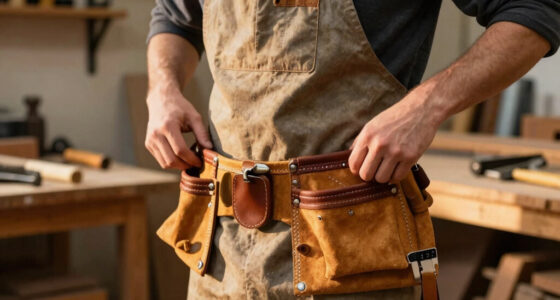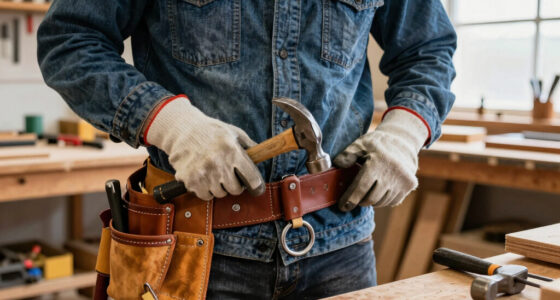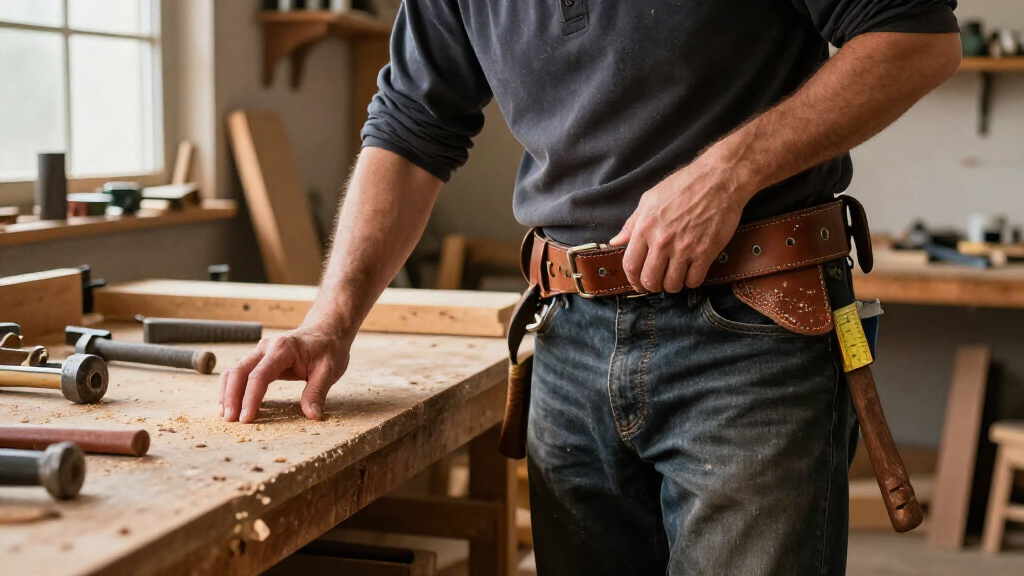

A heavy-duty work belt with tool loops has to do more than keep tools nearby: it must carry their weight without shifting, digging into your waist or wearing out too soon. The main choice is between a leather belt, which usually provides a firmer platform, and a nylon belt, which tends to be lighter and easier to adjust. A leather belt makes more sense for tradespeople carrying a substantial load day after day; nylon suits workers who value lower weight, flexible fit or changing tool setups. Construction and sizing vary by model, so check belt width, loop placement, stitching and compatibility with your tools before buying.

Get business pricing on tools and workshop supplies
- Business-only prices and quantity discounts
- Tax-exempt purchasing
- Multiple users, one account, clear invoices

Magnetic Tool Belt for Men – Adjustable Waist up to 51"
- ✔ Brand: Eswilran
- ✔ Material: 600D oxford
- ✔ Waist range: 31–52 inches

Arrow Tool Belt Heavy-Duty Electrician Tool Pouch with 10 Pockets
- ✔ Brand: Arrow
- ✔ Material: Polyester
- ✔ Construction: Triple-layer fabric

AWP Tool Belt Tool Rig – Premium Utility Belt Organizer
- ✔ Brand: AWP
- ✔ Material: 600-denier polyester
- ✔ Pockets: 18
At a Glance
| Criteria | Heavy-duty leather work belt with tool loops | Heavy-duty nylon work belt with tool loops | Winner |
|---|---|---|---|
| Load support and stability | Usually stiffer and better at holding a heavy load close to the body. | Can carry a useful load, but softer webbing may flex or shift when heavily loaded. | A |
| Durability | Can last for years with solid construction and basic care; stitching and leather quality matter. | Quality nylon resists abrasion and moisture; stitching, buckles and webbing remain wear points. | Depends |
| Comfort and weight | Heavier and less flexible, but its structure can spread a loaded setup more evenly. | Usually lighter and more flexible, which can feel better over long shifts. | B |
| Fit and adjustability | Often relies on fixed holes; sizing can be less forgiving over work clothing. | Many models adjust quickly and accommodate layers or changing waist sizes. | B |
| Tool-loop layout | Loop strength and spacing depend on design; rigid belts may keep tools from sagging. | Layouts vary widely; modular designs may make it easier to change tool placement. | Depends |
| Weather and upkeep | Can dry and crack if neglected or repeatedly soaked; benefits from occasional conditioning. | Typically easier to clean and less affected by rain, though wet gear still needs drying. | B |
| Price and value | Often costs more upfront, with value strongest for frequent, heavy use. | Often cheaper to buy and replace, making it attractive for lighter or occasional use. | B |
Magnetic Tool Belt for Men – Adjustable Waist up to 51"
The Eswilran Magnetic Tool Belt is our best overall pick because it combines the broadest stated adjustment range in this group with a dense layout for carrying different kinds of tools. Its listed waist range is 31–52 inches, and the 19 webbing loops add options for placing tools where they are easy to reach. That flexibility makes it more adaptable than Arrow, whose waist adjustment tops out at 49 inches and whose layout has 10 pockets.The headline figure is 37 pockets, but the more distinctive feature is the three magnetic zones. The description places them on the hammer holder and front pouches, where they can help keep nails or screws nearby during work. That can reduce repeated trips to a pouch for small metal fasteners, though the magnets are limited to specific areas and do not make every part of the belt a magnetic surface.Its 600D oxford fabric, double stitching, and metal rivets point to a reinforced design. The dual-side buckle is intended to adjust over different clothing layers, which may be useful as workwear changes through the year. The tradeoff is that the same robust materials and hardware contribute to a heavier feel, while the buckle arrangement may take some getting used to. Compared with AWP’s padded rig, Eswilran emphasizes storage access and fit range rather than distributing weight through shoulder padding. Choose it when pockets, loops, and fastener access take priority; skip it if you want a light, simple belt.
Pros:
- 31–52-inch stated waist range accommodates a broad range of fits and clothing layers.
- 37 pockets and 19 webbing loops offer many ways to separate and position gear.
- Three magnetic zones can keep small metal fasteners close at designated areas.
- Double stitching and metal rivets reinforce the 600D oxford construction.
Cons:
- Metal hardware and robust construction can make the belt feel heavy.
- Magnetic zones are limited to specific areas rather than spread across the belt.
- The dual-side buckle adjustment may take time to get familiar with.
Best for: Workers who want a wide stated waist range, many separate storage spots, and magnetic access to small metal fasteners.
Not ideal for: Buyers who prefer a lightweight, uncluttered belt or want magnetic holding areas throughout the tool layout.
Bottom line: We rank Eswilran first for its combination of broad fit adjustment, extensive tool organization, and targeted magnetic access, provided you can accept a substantial belt.
“We rank Eswilran first for its combination of broad fit adjustment, extensive tool organization, and targeted magnetic access, provided you can accept a substantial belt.”
Arrow Tool Belt Heavy-Duty Electrician Tool Pouch with 10 Pockets
Arrow takes a more restrained approach than the Eswilran: 10 pockets, exterior loops, internal compartments, a hammer holder, and a tape measure clip form a focused setup without the 37-pocket sprawl of our top pick. For electricians or other workers who carry a familiar selection of tools, this may make it easier to keep essentials grouped without filling every available space. Buyers who need to sort many small components may find Eswilran’s larger layout more accommodating.Its strongest construction detail is the combination of triple-layer fabric and reinforced 1200D pocket bottoms. Reinforcement at the bottom of the pockets is relevant where tools repeatedly rub against the material. Arrow also includes a reflective safety strip, giving it a visibility feature that neither competing belt lists. This is a practical differentiator for work around low-light conditions, although it does not replace any job-specific visibility equipment.The belt adjusts to a stated maximum waist of 49 inches and weighs 0.88 kg. That makes the fit limit narrower than Eswilran’s listed range and slightly below AWP’s 50-inch maximum. Its ergonomic design is described as helping reduce back fatigue, but it does not include AWP’s padded shoulder straps to support a rig-style carry. Arrow therefore suits buyers who want reinforced pouches and visibility details in a more compact organization scheme. We would look elsewhere if you need a very broad fit range or want maximum separation for a large tool collection.
Pros:
- Triple-layer fabric and reinforced 1200D pocket bottoms target wear at high-contact areas.
- Reflective strip adds a visibility detail for low-light work settings.
- Hammer holder, tape measure clip, loops, and internal compartments support a defined tool setup.
- Adjustable fit and ergonomic design are intended to support extended wear.
Cons:
- At 0.88 kg, it may feel heavier than a simpler belt.
- The stated waist adjustment stops at 49 inches.
- Its 10-pocket layout offers less separation than Eswilran’s 37 pockets.
Best for: Electricians and other tradespeople who want reinforced pocket bottoms, a specific set of storage features, and a reflective strip.
Not ideal for: Buyers with a waist above the stated 49-inch limit or those who need the largest pocket and loop capacity in this lineup.
Bottom line: We recommend Arrow for a focused, reinforced tool setup with reflective detailing, as long as its 49-inch fit limit and moderate pocket count meet your needs.
“We recommend Arrow for a focused, reinforced tool setup with reflective detailing, as long as its 49-inch fit limit and moderate pocket count meet your needs.”
AWP Tool Belt Tool Rig – Premium Utility Belt Organizer
AWP is the premium rig choice for buyers who want the belt to work as part of a supported carry system. It has 18 pockets and tool loops, but its defining difference from Arrow and Eswilran is the air-mesh padding on the shoulder, back, and waist straps. Those contact points may help make an organized load more comfortable to wear over a long shift. This format also means it is a larger setup than a simple waist belt, so it makes the most sense when you want the added support and expect to carry enough gear to use it.Construction pairs 600-denier polyester with reinforced seams. The 18 pockets give it more storage positions than Arrow’s 10, while leaving it less densely divided than Eswilran’s 37. That middle ground may suit someone who wants room for common tools without managing dozens of separate pockets. AWP’s carry handles also make the rig easier to move or store between jobs, a small but useful detail if the belt is kept assembled with tools.The key tradeoff is the rig’s size and fit. Its maximum waist measurement is 50 inches, between Arrow’s 49-inch limit and Eswilran’s stated 52-inch range, and the listing describes it as one size. Smaller users may find the fit oversized, while anyone wanting a compact belt may not want shoulder straps at all. Unlike Eswilran, AWP does not list magnetic zones or a particularly high pocket count. We rank it third overall because its comfort-oriented support serves a narrower need, but for buyers who value a padded rig over maximum storage density, that is the reason to choose it.
Pros:
- Air-mesh padding on shoulder, back, and waist straps supports a rig-style carry.
- 18 pockets and tool loops provide an intermediate amount of organization.
- 600-denier polyester and reinforced seams are specified for the construction.
- Carry handles simplify transport and storage.
Cons:
- One-size construction and a 50-inch maximum waist may feel oversized on smaller users.
- Shoulder straps and the larger rig format are more than some buyers need.
- It offers fewer pockets than Eswilran and no listed magnetic zones.
Best for: Contractors, electricians, mechanics, and handymen who want a padded belt-and-suspender rig for carrying tools over longer workdays.
Not ideal for: Smaller users concerned about the one-size fit, or buyers who want a compact belt, magnetic zones, or the most pockets.
Bottom line: AWP is the right pick when padded shoulder and waist support matters more than a compact layout or the highest pocket count.
“AWP is the right pick when padded shoulder and waist support matters more than a compact layout or the highest pocket count.”
As an Amazon Associate we earn from qualifying purchases.
Key Differences
The practical difference starts with how each belt handles weight. A stiff leather belt tends to resist folding and sagging, which can help keep a loaded set of tools stable while bending, climbing or moving around a job site. Nylon is often more comfortable when empty and easier to adapt to different clothing, but softer webbing may flex under a heavy load. A thick, reinforced nylon model can narrow that gap, so construction matters more than the material label alone.
Value depends on how often the belt is used and how much it carries. A well-made leather belt can justify a higher initial price for someone who wears it daily and needs firm support. Nylon is often the better buy for lighter loads, changing tasks, wet conditions or tighter budgets. In either case, the best fit is the belt that stays secure without pressing uncomfortably into the waist. Compare its width and buckle with your existing pouches, and check that the loops hold your actual tools rather than merely looking sturdy.
Detailed Comparison
Load support and stability (Heavy-duty leather work belt with tool loops wins — major)
Leather wins for consistently heavy loads; the difference is major when the belt carries several dense tools. Its firmer construction generally resists sagging and helps keep tools close to the body. Nylon can work well for a lighter kit, but flexible webbing may bow or shift as weight increases. Reinforced nylon models can perform better, so look for load guidance and stiffened sections if choosing nylon.
Durability (moderate difference)
This is a model-dependent tie. Quality leather can hold up through years of regular use, but poor care or repeated exposure to water can dry it out or damage it. Quality nylon handles abrasion and damp conditions well, but frayed stitching, worn webbing or a failing buckle can end its useful life. Inspect seams, stress points and hardware rather than assuming one material always lasts longer.
Comfort and weight (Heavy-duty nylon work belt with tool loops wins — moderate)
Nylon wins on lightness and flexibility; the gap is moderate over a long shift. It usually feels less bulky and can move more freely as you crouch or climb. Leather adds weight but may feel steadier once loaded because its structure resists folding. For comfort, consider the belt with tools attached, its edge finish and whether its width spreads pressure across your waist.
Fit and adjustability (Heavy-duty nylon work belt with tool loops wins — moderate)
Nylon usually wins, by a moderate margin. Many nylon belts offer quick adjustment and room for layers, which helps when temperatures or work clothes change. Leather belts with fixed holes can provide a secure, familiar fit, but may offer fewer adjustment points. Check the usable size range on the specific belt; adjustment style and buckle design differ across both materials.
Tool-loop layout (minor difference)
Neither material wins on its own; this is a minor, design-led difference. A rigid leather belt may keep loops and tools from folding inward, while modular nylon systems can make it easier to reposition holders for different tasks. Count and placement matter more than material: confirm the loops fit your hammer, tape measure, pliers or other tools and that the arrangement leaves your movement unobstructed.
Weather and upkeep (Heavy-duty nylon work belt with tool loops wins — moderate)
Nylon wins, with a moderate advantage for wet or dirty work. It is generally easier to wipe clean and less prone to drying out after exposure to rain. Leather benefits from drying properly and occasional conditioning, and persistent dampness can shorten its life. Nylon still needs care: let wet gear dry and check for damaged seams or hardware. If your work is mostly indoors, this difference matters less.
Price and value (Heavy-duty nylon work belt with tool loops wins — moderate)
Nylon is usually the better value for lighter use; the difference is moderate. It often costs less upfront and can be a sensible choice for occasional jobs or a changing tool setup. A leather belt can be worth paying more for when its added structure supports a heavy kit every working day and its build quality is high. Compare the construction and expected workload, not price alone.
Heavy-duty leather work belt with tool loops: Pros and Cons
Pros:
- Firm structure can help stabilize a heavy set of tools.
- Often a good match for daily trade work and a fixed tool load.
- A quality belt can provide long service with appropriate care.
Cons:
- Usually heavier and less flexible than nylon.
- Fixed-hole sizing may be less convenient over changing layers.
- Higher upfront cost and more care around moisture.
Heavy-duty nylon work belt with tool loops: Pros and Cons
Pros:
- Typically lighter and more flexible through a long workday.
- Adjustment is often quick, and modular designs may suit changing tasks.
- Usually easier to clean and less expensive to buy.
Cons:
- Softer models can sag or shift under a heavy load.
- Webbing, stitching and buckles can wear and need inspection.
- A very flexible belt may feel less supportive with dense tools.
Who Should Choose What
Choose Heavy-duty leather work belt with tool loops if:
- You carry several heavy tools for most of the workday and want a firm platform.
- Your tool arrangement stays fairly consistent and you value stability over low weight.
- You are willing to pay more upfront and care for leather to get long-term daily use.
Choose Heavy-duty nylon work belt with tool loops if:
- Your kit is light or changes between jobs, and flexibility matters more than maximum stiffness.
- You work in damp or dirty conditions and want simpler cleanup.
- You need a more adjustable fit over different work clothes or want to spend less upfront.
Skip both if: Your tools are heavy enough to require a purpose-built suspenders or harness setup, or neither belt fits securely and comfortably with your pouches attached.
Value for Money
Pay more for leather when you will load it heavily and wear it often: its added structure can make a practical difference in stability, and a well-built belt may serve for years. For a light kit, occasional projects or frequent changes in clothing and tool placement, nylon usually gives better value at a lower purchase price. Do not pay extra for material alone. A sound buckle, reinforced attachment points, secure stitching and a comfortable fit affect usefulness just as much. If possible, compare belts while loaded, since an empty belt can hide sagging or pressure points.
Final Verdict
Choose a heavy-duty leather work belt with tool loops for daily trade work when support for a substantial, consistent tool load is your main priority. Choose nylon when lower weight, easy adjustment, wet-weather practicality or lower upfront cost matters more, especially with a lighter kit. For most users carrying heavy tools all day, leather is the stronger choice if the fit and construction are sound. The deciding factor is the loaded setup: if a nylon belt stays stable and comfortable with your tools attached, it can save weight and money; if it flexes or shifts, pay more for the structure of leather.
Frequently Asked Questions
Is a leather or nylon work belt better for heavy tools?
Leather is generally the better starting point for a heavy, steady load because its stiffness can help limit sagging. A reinforced nylon belt may also work, but inspect its support and stitching and test it with your tools attached.
Are nylon tool belts durable enough for daily work?
Yes, a well-made nylon belt can handle daily use, particularly in damp or dirty settings. Check the webbing, seams, buckle and attachment points regularly; durability depends on the belt’s construction and workload.
Is a more expensive leather belt worth the price?
It can be worth the added cost if you wear it daily and carry a heavy load that benefits from a firm platform. For lighter or occasional use, a good nylon belt is often the better value.
What should I check before buying a work belt with loops?
Check the belt width, size range, buckle, loop spacing and whether each loop fits your tools. Look at stitching and reinforced stress points, then consider how the loaded belt feels when you bend and move.