

When it comes to the best Carhartt work jackets, the Carhartt Men’s Washed Duck Sierra Jacket earns the top spot for balancing rugged cotton-duck durability with a broken-in feel from day one. Close behind, the Firm Duck Thermal-Lined Active Jacket delivers dependable three-season warmth at a working-person’s price, while the Gilliam Jacket stands out as the lightest, most flexible option for high-movement indoor and shoulder-season jobs. The main tradeoff you’ll face in this lineup is between firm duck toughness and flexibility and weight — the classic fabrics shrug off abuse but feel stiff, while the Rugged Flex and Full Swing lines move better but trade a little of that legendary abrasion resistance. Sizing and insulation are the other big decision points, since Carhartt’s relaxed cuts run generous and some linings are built for bitter cold while others suit mild weather. Keep reading for the full breakdown of all 15 jackets and which one fits your trade, climate and budget.

Get business pricing on tools and workshop supplies
- Business-only prices and quantity discounts
- Tax-exempt purchasing
- Multiple users, one account, clear invoices
Complete the kit


Key Takeaways
- The Washed Duck Sierra Jacket took the top spot because it delivers the classic Carhartt duck-shell durability without the long break-in period that firm duck jackets demand.
- Firm duck models like the J140 Active Jacket and J01 Detroit Jacket are the toughest options in the lineup, but buyers should expect stiffness and a heavier feel for the first several weeks of wear.
- Full Swing and Rugged Flex jackets (Berwick, Quick Duck, Ripstop Insulated) solve the mobility problem with flex panels and lighter fabrics — the right call for anyone doing overhead work like electrical, framing or mechanic jobs.
- Lining choice matters more than shell choice for comfort: flannel and thermal linings suit cold outdoor sites, while the unlined and lightly insulated options like the Gilliam and Monterey work better for layering or indoor trades.
- Specialist picks — the HV Sherwood Class 3 for high-visibility compliance and the Flame-Resistant Quick Duck Coat for arc-rated protection — fill mandatory-safety roles that no general-purpose jacket can replace on regulated job sites.
| Carhartt Men’s Washed Duck Sierra Jacket |  | Best Overall Winter Warmth | Fabric: 100% cotton washed duck | Body Lining: Sherpa | Sleeve Lining: Quilted nylon | VIEW LATEST PRICE | See Our Full Breakdown |
| Carhartt Men’s Loose Fit Firm Duck Thermal-Lined Active Jacket |  | Best Classic Workhorse | Fabric: 100% cotton firm duck | Lining: Polyester thermal | Closure: Zipper | VIEW LATEST PRICE | See Our Full Breakdown |
| Carhartt Men’s Washed Duck Bartlett Jacket |  | Best for Hooded Everyday Warmth | Shell Fabric: 12-ounce ring-spun washed duck, 100% cotton | Body Lining: Sherpa | Sleeve Lining: Quilted | VIEW LATEST PRICE | See Our Full Breakdown |
| Carhartt Men’s HV Sherwood Class 3 Jacket |  | Best for High-Visibility and Wet Weather | Fabric: 100% polyester | Lining: Quilted brushed polyester | Visibility Standard: ANSI/ISEA 107 Class 3, Type R | VIEW LATEST PRICE | See Our Full Breakdown |
| Carhartt Men’s Big-Tall Quilted Flannel Lined Sandstone Active Jacket |  | Best for Big and Tall Fit | Fabric: 100% cotton sandstone | Lining: Quilted flannel body | Hood: Attached quilted flannel-lined with drawcord | VIEW LATEST PRICE | See Our Full Breakdown |
| Carhartt Men’s Iconic J140 Firm Duck Active Jacket |  | Best Classic Cold-Weather Work Jacket | Fabric: 100% cotton firm duck | Fit: Loose | Lining: Flannel-lined body | VIEW LATEST PRICE | See Our Full Breakdown |
| Carhartt Men’s Washed Duck Active Jacket |  | Best for Immediate Comfort | Fabric: 100% ring-spun cotton washed duck | Fabric weight: 12 ounces | Lining: Quilted nylon | VIEW LATEST PRICE | See Our Full Breakdown |
| Carhartt Men’s Rugged Flex Duck Berwick Jacket |  | Best for Mobility | Fabric: 99% cotton, 1% spandex duck canvas | Fit: Relaxed | Stretch: Rugged Flex technology | VIEW LATEST PRICE | See Our Full Breakdown |
| Carhartt Men’s Firm Duck Traditional Coat |  | Best for Extreme Cold | Fabric: 100% cotton firm duck | Lining: Quilted nylon | Insulation: Arctic-weight polyester | VIEW LATEST PRICE | See Our Full Breakdown |
| Carhartt Men’s Iconic J01 Duck Detroit Jacket |  | Best Style-and-Work Crossover | Fabric: 100% ring-spun cotton duck | Fabric weight: 12 oz | Lining: Blanket lining in body, quilted nylon in sleeves | VIEW LATEST PRICE | See Our Full Breakdown |
| Carhartt Men’s Full Swing Relaxed Fit Ripstop Insulated Jacket | 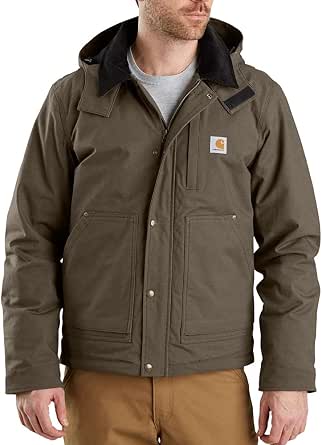 | Best Rugged All-Rounder | Fabric: 73% Cotton, 24% Cordura Nylon, 3% Spandex | Fabric Weight: 10 oz | Insulation: 80-gram 3M Thinsulate | VIEW LATEST PRICE | See Our Full Breakdown |
| Carhartt Men’s Monterey Jacket |  | Best Waterproof Rain Option | Fabric: 100% Nylon | Technology: Storm Defender, Wind Fighter | Seam Construction: Fully-taped waterproof seams | VIEW LATEST PRICE | See Our Full Breakdown |
| Carhartt Men’s Full Swing Loose Fit Quick Duck Insulated Jacket |  | Best Lightweight Mobility Pick | Fabric: 59% Cotton, 39% Polyester, 2% Spandex | Fabric Weight: 8.25 oz | Water Resistance: Rain Defender durable water repellent | VIEW LATEST PRICE | See Our Full Breakdown |
| Carhartt Men’s Flame-Resistant Full Swing Relaxed-Fit Quick Duck Insulated Coat |  | Best for Hazardous Work Environments | Fabric: 88% Cotton, 12% Nylon | Fabric Weight: 8.5 oz | Insulation: 150-gram 3M Thinsulate Platinum | VIEW LATEST PRICE | See Our Full Breakdown |
| Carhartt Men’s Gilliam Jacket |  | Best Everyday Insulated Layer | Fabric Type: 100% Nylon | Lining: Nylon | Insulation: 100-gram polyester | VIEW LATEST PRICE | See Our Full Breakdown |
| Carhartt work jacket | Fabric | Care | Pockets | Lining |
|---|---|---|---|---|
| Carhartt Men’s Washed Duck Sie | 100% cotton washed duck | Machine wash | 2 inside, 2 sherpa-lined lower-front | — |
| Carhartt Men’s Loose Fit Firm | 100% cotton firm duck | Machine wash warm, tumble dry medium | 2 inside, 2 large lower-front | Polyester thermal |
| Carhartt Men’s Washed Duck Bar | — | Machine wash | — | — |
| Carhartt Men’s HV Sherwood Cla | 100% polyester | — | Multiple work pockets including waterproof chest pocket | Quilted brushed polyester |
| Carhartt Men’s Big-Tall Quilte | 100% cotton sandstone | — | 2 large lower-front, 2 inside | Quilted flannel body |
| Carhartt Men’s Iconic J140 Fir | 100% cotton firm duck | Machine wash | Two large front pockets | Flannel-lined body |
| Carhartt Men’s Washed Duck Act | 100% ring-spun cotton washed duck | Machine wash | Lower front with brushed tricot lining, reinforced bottoms, pen stall in right pocket | Quilted nylon |
| Carhartt Men’s Rugged Flex Duc | 99% cotton, 1% spandex duck canvas | Machine wash | 2 snap chest, 2 lower side-entry, 2 interior (hook-and-loop and zippered) | — |
| Carhartt Men’s Firm Duck Tradi | 100% cotton firm duck | Machine wash | — | Quilted nylon |
| Carhartt Men’s Iconic J01 Duck | 100% ring-spun cotton duck | Machine wash | Left-chest pocket with zipper closure | Blanket lining in body, quilted nylon in sleeves |
| Carhartt Men’s Full Swing Rela | 73% Cotton, 24% Cordura Nylon, 3% Spandex | Machine wash | — | Nylon taffeta |
| Carhartt Men’s Monterey Jacket | 100% Nylon | Machine wash | Multiple zip pockets | — |
| Carhartt Men’s Full Swing Loos | 59% Cotton, 39% Polyester, 2% Spandex | Machine wash | — | — |
| Carhartt Men’s Flame-Resistant | 88% Cotton, 12% Nylon | Machine wash | — | — |
| Carhartt Men’s Gilliam Jacket | — | Machine wash | Left-chest map pocket, two lower-front pockets, two inside pockets | Nylon |
More Details on Our Top Picks
Carhartt Men’s Washed Duck Sierra Jacket
This option stands out for combining sherpa-lined body warmth with a softer, pre-washed duck shell that skips the stiff break-in period of the Firm Duck Active Jacket. The quilted-nylon sleeves matter more than they sound: they let arms slide over base layers easily, where full sherpa sleeves in heavier coats can bind. Pleated elbows and split-back construction give it better reach than the blockier Traditional Coat. The tradeoff is weight and breathability — this jacket runs hot, and unlike the HV Sherwood below, no water resistance is specified, so a wet job site is not its home.
Pros:- Sherpa body lining delivers serious cold-weather warmth
- Quilted nylon sleeves make layering and arm movement easier
- Rib-knit storm cuffs block wind at the wrist
- Pleated elbows and split back improve reach and mobility
Cons:- Heavy cotton duck construction weighs the jacket down
- No water resistance for rain or wet conditions
- Sherpa lining is too warm for mild-weather use
Best for: Outdoor workers in genuinely cold climates who want deep warmth without a stiff new-canvas break-in
Not ideal for: People working in mild or variable weather — the sherpa lining turns it into a sauna indoors or on warmer days
- Fabric:100% cotton washed duck
- Body Lining:Sherpa
- Sleeve Lining:Quilted nylon
- Pockets:2 inside, 2 sherpa-lined lower-front
- Cuffs:Inner-sleeve rib-knit storm cuffs
- Construction:Pleated elbows, split back
- Care:Machine wash
Our verdict“This pick makes the most sense for cold-climate tradespeople who prioritize warmth and mobility over weatherproofing.”
Carhartt Men’s Loose Fit Firm Duck Thermal-Lined Active Jacket
Compared with the softer Washed Duck Sierra, this model leans into Carhartt’s harder-edged heritage: firm duck canvas that starts stiff but outlasts nearly everything else in the lineup. The thermal lining is lighter than sherpa, making it a better four-season jacket for high-activity jobs where the Sierra would overheat you. The attached draw-cord hood gives it an edge over hoodless staples like the J01 Detroit Jacket when the weather turns. Tradeoffs are real: the loose fit runs baggy on leaner frames, and the cotton shell soaks through and dries slowly in sustained rain.
Pros:- Firm duck construction is exceptionally abrasion-resistant
- Thermal lining adds warmth without bulk or overheating
- Attached adjustable hood adds weather coverage
- Two inside pockets secure phones and wallets
Cons:- Baggy loose fit can feel sloppy on slimmer builds
- Cotton exterior absorbs water and dries slowly
- Firm duck needs a break-in period before it flexes easily
Best for: Tradespeople who want a rugged, long-life daily driver with room to layer over sweatshirts
Not ideal for: Anyone needing rain protection or a trimmer silhouette — the cotton shell and loose cut work against both
- Fabric:100% cotton firm duck
- Lining:Polyester thermal
- Closure:Zipper
- Hood:Attached thermal-lined with draw-cord
- Pockets:2 inside, 2 large lower-front
- Cuffs and Waistband:Rib-knit
- Fit:Loose
- Care:Machine wash warm, tumble dry medium
Our verdict“This is the jacket for buyers who value durability and layering room over polish and weatherproofing.”
Carhartt Men’s Washed Duck Bartlett Jacket
The Bartlett splits the difference between the Sierra and the thermal-lined Active Jacket: sherpa body warmth like the Sierra, but with an attached low-profile hood the Sierra lacks. Its 12-ounce ring-spun washed duck is slightly lighter and softer from day one than the Firm Duck Active Jacket’s shell. The Cordura-reinforced sleeve hems address a common failure point — fraying cuffs — that plain duck jackets develop after a season or two of hard wear. On the downside, the hood’s adjustment range is limited, and like most cotton options here, it offers no meaningful rain protection.
Pros:- 12-ounce ring-spun washed duck is durable yet broken-in soft
- Sherpa-lined body handles deep cold
- Cordura-reinforced sleeve hems resist fraying at a high-wear point
- Quilted sleeves layer smoothly over base layers
Cons:- Cotton shell provides no waterproofing
- Sherpa lining adds bulk under harnesses or straps
- Hood adjustment range is limited
Best for: Buyers who want sherpa-level warmth plus a hood for commuting and mixed indoor-outdoor work
Not ideal for: Workers who need precise hood fit in wind — the low-profile adjustment has limited range
- Shell Fabric:12-ounce ring-spun washed duck, 100% cotton
- Body Lining:Sherpa
- Sleeve Lining:Quilted
- Sleeve Hem:Cordura reinforced with inner rib-knit cuff
- Hood:Attached with low-profile adjustment
- Care:Machine wash
Our verdict“This model suits buyers who want the Sierra’s warmth with a hood included, at the cost of adjustability and weather protection.”
Carhartt Men’s HV Sherwood Class 3 Jacket
This is the only jacket in this batch that solves the problem the cotton options can’t: rain and visibility at once. The polyester shell with Rain Defender DWR and fully taped seams makes it genuinely waterproof, while the Sierra, Bartlett, and Firm Duck Active Jacket all soak through. Meeting ANSI Class 3, Type R standards, it’s built for roadside and traffic-adjacent work where being seen is a safety requirement, not a preference. The compromises: it sacrifices the breathable natural-fiber feel of cotton duck, the reflective rating holds for only 75 home launderings, and the loose fit swamps smaller frames.
Pros:- ANSI/ISEA 107 Class 3 Type R certified visibility
- Waterproof shell with fully taped seams for sustained rain
- Quilted brushed polyester lining adds cold-weather comfort
- Waterproof chest pocket protects electronics
Cons:- Reflective performance is rated for only 75 home launderings
- Loose fit feels bulky on smaller builds
- Polyester shell lacks the breathability of cotton duck
Best for: Road crews, utility workers, and flaggers who need certified visibility plus real rain protection
Not ideal for: Buyers who prefer natural-fiber breathability or need a trim fit — this runs roomy and synthetic
- Fabric:100% polyester
- Lining:Quilted brushed polyester
- Visibility Standard:ANSI/ISEA 107 Class 3, Type R
- Reflective Durability:Rated through 75 home launderings
- Water Resistance:Rain Defender DWR, fully taped waterproof seams
- Fit:Loose
- Pockets:Multiple work pockets including waterproof chest pocket
Our verdict“If your job site demands certified visibility and dry conditions, this is the clear choice over every cotton option here.”
Carhartt Men’s Big-Tall Quilted Flannel Lined Sandstone Active Jacket
What separates this Active Jacket is sizing: with a 30-inch back length in Large Tall, it actually covers taller torsos, where standard-cut options like the Bartlett leave a cold gap at the waist. The quilted flannel lining sits between thermal and sherpa in warmth — more comfortable in shoulder seasons than the sherpa-packed Sierra, less specialized than a winter parka. The flannel-lined drawstring hood adds coverage the J01 Detroit Jacket goes without. Be aware that sizing runs snug between measurements, so upsizing is often the safer call, and like the other cotton jackets here, it won’t shrug off rain or strong wind.
Pros:- Extended tall sizing with 30-inch back length covers longer torsos
- Quilted flannel lining balances warmth and breathability
- Flannel-lined attached hood with drawcord adds coverage
- Rib-knit cuffs and waistband seal in warmth
Cons:- No water resistance for rain
- Cotton shell blocks wind less effectively than synthetic outerwear
- Sizing runs small between measurements
Best for: Tall or big-framed workers who struggle with short-waisted standard jackets and want moderate warmth
Not ideal for: Buyers in harsh wind or rain — the cotton shell and flannel lining aren’t built for severe weather
- Fabric:100% cotton sandstone
- Lining:Quilted flannel body
- Hood:Attached quilted flannel-lined with drawcord
- Closure:Front zip
- Cuffs and Waistband:Rib-knit
- Pockets:2 large lower-front, 2 inside
- Back Length:28 in (Large Regular), 30 in (Large Tall)
Our verdict“This pick makes the most sense for big and tall buyers who need real length coverage and everyday warmth rather than extreme-weather protection.”
Carhartt Men’s Iconic J140 Firm Duck Active Jacket
The J140 is the archetype of what most people picture when they hear “Carhartt jacket”: stiff firm duck canvas that softens over years, a flannel-lined body, and a quilted hood with a draw-cord to seal in warmth. Compared with the J01 Duck Detroit Jacket, the J140 trades the Detroit’s blanket lining and collar-only insulation for full-body flannel warmth, which makes it the better choice when temperatures drop but the less versatile pick for shoulder seasons. The loose fit is a genuine feature here — it accommodates heavy layers underneath — though buyers who want a jacket that works off the job site will find the silhouette boxy.
Pros:- Flannel-lined body delivers genuine cold-weather warmth
- Firm duck cotton is extremely abrasion-resistant and breaks in over time
- Roomy loose fit layers easily over sweatshirts or hoodies
- Quilted hood with draw-cord keeps wind off the neck and ears
Cons:- Firm duck fabric starts stiff and takes considerable wear to break in
- Loose fit looks and feels bulky on slimmer frames
Best for: Outdoor laborers and tradespeople who work through freezing conditions and need room for heavy base layers
Not ideal for: Anyone wanting a jacket that doubles as casual everyday wear — the boxy loose fit and stiff firm duck read purely as workwear
- Fabric:100% cotton firm duck
- Fit:Loose
- Lining:Flannel-lined body
- Hood:Quilted with draw-cord closure
- Pockets:Two large front pockets
- Care:Machine wash
- Origin:Imported
Our verdict“This is the pick for buyers who want the traditional stiff-duck Carhartt experience with serious winter warmth built in.”
Carhartt Men’s Washed Duck Active Jacket
The washed duck version solves the single biggest complaint about the J140 Firm Duck Active Jacket: stiffness. Because the 12-ounce cotton is pre-washed, this jacket arrives broken-in and comfortable from day one, with none of the cardboard-like break-in period firm duck demands. It also upgrades the insulation game — 80g 3M Thinsulate runs through the body, sleeves, and hood, compared with the J140’s flannel body alone, so warmth is more even and less bulky. The brushed tricot pocket linings are a small luxury that cold-handed workers will notice daily. The tradeoff is longevity: washed duck, while softer, generally shows wear sooner than firm duck, and it lacks the rugged, aging-like-leather character traditionalists want.
Pros:- Pre-washed fabric is comfortable immediately with no break-in
- Thinsulate insulation in body, sleeves, and hood for even warmth
- Reinforced pocket bottoms resist wear from tools and keys
- Brushed tricot pocket lining warms cold hands quickly
Cons:- Washed duck is less abrasion-resistant than firm duck over the long haul
- Thinsulate can feel overly warm during active, high-exertion work
Best for: Workers who hate stiff new jackets and want full insulation, including in the sleeves, without a break-in period
Not ideal for: Buyers prioritizing maximum durability — the softer washed finish sacrifices some of firm duck’s abrasion resistance
- Fabric:100% ring-spun cotton washed duck
- Fabric weight:12 ounces
- Lining:Quilted nylon
- Insulation:80g 3M Thinsulate in body, sleeves, and hood
- Hood:Attached with low-profile hem adjustment
- Pockets:Lower front with brushed tricot lining, reinforced bottoms, pen stall in right pocket
- Care:Machine wash
- Origin:Imported
Our verdict“This is the softened, fully insulated take on the classic active jacket for anyone who values out-of-the-box comfort.”
Carhartt Men’s Rugged Flex Duck Berwick Jacket
Most Carhartt duck jackets resist movement by design — stiff canvas that eventually molds to your body. The Berwick takes a different approach, blending 1% spandex into the duck canvas via Rugged Flex stretch technology, so reaching, crouching, and swinging tools feels natural from the first wear. Where the J140 offers zero give and the Firm Duck Traditional Coat relies on bi-swing pleats to compensate, the Berwick builds stretch directly into the fabric. Storage is the other headline: six pockets, including a zippered interior pocket for a phone or wallet that none of the other jackets in this lineup match. The relaxed cut runs generous, so sizing down may be wise, and it lacks a hood — a real gap for anyone working in rain or snow.
Pros:- Built-in stretch makes it far more mobile than traditional firm duck jackets
- Six pockets including a secure zippered interior compartment
- Snap-adjustable drop-tail hem keeps the lower back covered
- Duck canvas construction holds up to jobsite abuse
Cons:- No hood or insulation limits it to mild, dry conditions
- Relaxed fit runs large and can swallow slimmer builds
Best for: Carpenters, mechanics, and tradespeople whose work involves constant bending, reaching, and overhead movement
Not ideal for: Workers who need rain or snow protection — there’s no hood and no insulation, making this a dry-weather layer only
- Fabric:99% cotton, 1% spandex duck canvas
- Fit:Relaxed
- Stretch:Rugged Flex technology
- Hem:Snap-adjustable drop-tail
- Pockets:2 snap chest, 2 lower side-entry, 2 interior (hook-and-loop and zippered)
- Care:Machine wash
- Origin:Imported
Our verdict“The Berwick is the choice when range of motion and storage matter more than weather protection.”
Carhartt Men’s Firm Duck Traditional Coat
When winter gets serious, this coat outguns everything else in this batch. The arctic-weight polyester insulation and quilted nylon lining put it a full tier above the J140’s flannel lining or the Washed Duck Active Jacket’s 80g Thinsulate — this is the jacket for sub-zero job sites, not chilly autumn mornings. The Wind Fighter technology adds windproofing that lighter active jackets simply don’t offer, and the two-way brass zipper with storm flap seals the front against gusts. Carhartt clearly thought about labor here too: the pleated bi-swing back and split-back construction preserve reach even in a long, heavy coat. The cost is weight and bulk — this is a genuine coat, not a layering piece, and it will overwhelm milder climates.
Pros:- Arctic-weight insulation is the warmest option in this lineup
- Wind Fighter technology blocks gusts that defeat lighter jackets
- Bi-swing back and split construction allow reaching despite the long cut
- Two-way brass zipper with storm flap seals out weather securely
Cons:- Heavy and bulky, making it impractical for layering or mild days
- Full-length coat cut restricts driving and cab work compared with waist-length jackets
Best for: Workers in genuinely harsh winter climates who need maximum insulation and wind protection for long outdoor shifts
Not ideal for: Mild-climate buyers or anyone doing high-exertion work — the arctic insulation causes overheating fast
- Fabric:100% cotton firm duck
- Lining:Quilted nylon
- Insulation:Arctic-weight polyester
- Wind protection:Wind Fighter technology
- Back construction:Split-back with pleated bi-swing back
- Closure:Two-way brass zipper with hook-and-loop storm flap
- Care:Machine wash
- Origin:Imported
Our verdict“This is the deep-winter workhorse for buyers who need serious warmth and wind protection above all else.”
Carhartt Men’s Iconic J01 Duck Detroit Jacket
The J01 Detroit occupies a unique position: it’s a legitimate work jacket that also looks right at a bar on Friday night. The corduroy-trimmed collar, shorter waist-length cut, and blanket lining give it a heritage look the longer, boxier J140 Active Jacket can’t match. Functionally, the hybrid lining is clever — blanket lining in the body, quilted nylon in the sleeves — so the torso stays warm while the arms slip easily over base layers. Under-collar snaps accept an optional hood, adding versatility the design-first silhouette hides well. Compared with the Berwick, storage is minimal: one zippered chest pocket and hand pockets won’t satisfy tool-heavy trades. And like all firm duck, the 12-ounce fabric is heavy and warm, ruling out mild-weather use.
Pros:- Iconic heritage styling transitions from jobsite to casual wear
- Hybrid lining keeps the torso warm while sleeves layer easily
- Corduroy collar with under-collar snaps for adding an optional hood
- 12-ounce ring-spun cotton duck is built for years of wear
Cons:- Minimal pocket capacity compared with other jackets in this lineup
- Heavy duck fabric is too warm for spring, fall, or indoor work
Best for: Buyers who split time between the jobsite and town and want one jacket that works in both settings
Not ideal for: Workers who carry multiple tools or gadgets — the single chest pocket can’t compete with six-pocket options like the Berwick
- Fabric:100% ring-spun cotton duck
- Fabric weight:12 oz
- Lining:Blanket lining in body, quilted nylon in sleeves
- Collar:Corduroy-trimmed with snaps for optional hood
- Pockets:Left-chest pocket with zipper closure
- Care:Machine wash
- Origin:Imported
Our verdict“The Detroit is the pick when you want authentic Carhartt durability in a jacket you can wear everywhere, not just on the clock.”
Carhartt Men’s Full Swing Relaxed Fit Ripstop Insulated Jacket
Cordura ripstop construction is what separates this jacket from the standard duck cloth Carhartt lineup. Where the Washed Duck Active Jacket relies on heavyweight cotton canvas, this model blends cotton with Cordura nylon and spandex, so it resists tears while still moving with you — a combination traditional duck can’t match. The Full Swing system (bi-swing back, flex elbows, underarm gussets) makes overhead work noticeably less restrictive than in the J01 Duck Detroit Jacket, which has zero stretch. Inside, 80-gram 3M Thinsulate with a nylon taffeta lining delivers real warmth without the bulk of a thermal-lined sandstone coat. The tradeoff: at 10 ounces with insulation, this is too much jacket for spring jobsites or indoor work, and it carries the same imported origin as most of the current lineup rather than Carhartt’s USA-made heritage pieces.
Pros:- Cordura ripstop fabric resists tearing far better than plain canvas
- 80-gram 3M Thinsulate provides serious cold-weather warmth
- Full Swing bi-swing back and gussets allow overhead movement without riding up
- Rain Defender finish sheds light rain and morning moisture
Cons:- Heavy 10-oz insulated build is overkill for mild or variable weather
- Imported, unlike Carhartt’s USA-made firm duck options
Best for: Tradespeople doing heavy outdoor labor in cold weather who tear through ordinary canvas jackets
Not ideal for: Workers in mild climates or those who move between heated indoor and outdoor spaces — the 10-oz insulated build will overheat them
- Fabric:73% Cotton, 24% Cordura Nylon, 3% Spandex
- Fabric Weight:10 oz
- Insulation:80-gram 3M Thinsulate
- Lining:Nylon taffeta
- Water Resistance:Rain Defender durable water repellent
- Fit:Relaxed
- Care:Machine wash
- Origin:Imported
Our verdict“This is the pick for someone who works outdoors all winter and needs tear resistance and warmth in one jacket — not for fair-weather wear.”
Carhartt Men’s Monterey Jacket
Most jackets in this roundup only shrug off moisture — the Monterey actually seals it out. With fully taped seams, waterproof zippers, and Storm Defender technology, it does something the Rain Defender-equipped Full Swing Ripstop Jacket and the Washed Duck Bartlett Jacket cannot: keep you dry in sustained rain. The Wind Fighter construction and adjustable hood, cuffs, and hem let you dial in the fit when weather turns ugly, and the entire jacket packs into its own pocket, making it the obvious glovebox or truck-cab backup. That minimalism is also its weakness. There is no insulation to speak of, so compared with the Thinsulate-lined options here, the Monterey is a shell, not a standalone winter jacket. If you need warmth and waterproofing together, you’ll wear this over an insulated layer.
Pros:- Fully taped seams and waterproof zippers deliver genuine rain protection, not just repellency
- Storm Defender and Wind Fighter technologies block both rain and cutting wind
- Packs into its own pocket for easy carry
- Adjustable hood, cuffs, and hem seal out drafts
Cons:- No insulation means it cannot serve as a primary winter jacket
- Featherweight build is less abrasion-resistant than duck cloth workwear
Best for: Outdoor workers and commuters in wet, windy regions who need a truly waterproof layer they can stash in a truck or bag
Not ideal for: Anyone expecting cold-weather protection — this is an uninsulated rain shell that needs layering below freezing
- Fabric:100% Nylon
- Technology:Storm Defender, Wind Fighter
- Seam Construction:Fully-taped waterproof seams
- Hood:Adjustable
- Cuffs:Adjustable
- Hem:Adjustable
- Pockets:Multiple zip pockets
- Packability:Packs into pocket
- Care:Machine wash
Our verdict“Buy this for wet-weather protection that duck canvas can’t provide — just plan on layering it when temperatures drop.”
Carhartt Men’s Full Swing Loose Fit Quick Duck Insulated Jacket
The pitch here is simple: duck-tough durability at 30% less weight than sandstone. Compared with the J140 Firm Duck Active Jacket, which feels like armor when you first put it on, the 8.25-ounce Quick Duck fabric breaks in easier, breathes better, and won’t drag on you by hour ten of a shift. The Rugged Flex spandex weave plus a bi-swing back and flex elbows give it the same movement advantages as the Full Swing Ripstop Jacket above, but in a lighter, more mobile package for shoulder-season work. What you give up is warmth and some longevity — this is a lighter-duty shell than the 10-oz Cordura model, with no insulation listed, and like nearly everything else in this lineup it’s imported rather than USA-made. Think of it as the jacket for people who found traditional duck too stiff and too hot.
Pros:- 30% lighter than sandstone duck while matching it ounce-for-ounce on durability
- Rugged Flex stretch technology keeps the jacket from binding during physical work
- Bi-swing back and flex elbows support full overhead reach
- Rain Defender finish handles light rain and drizzle
Cons:- No insulation, so it needs layering in cold weather
- Lighter fabric will wear out faster than 12-oz firm duck under heavy abrasion
Best for: Carpenters, warehouse workers, and tradespeople who want duck-level toughness without the weight during spring through fall
Not ideal for: Winter jobsite use — the uninsulated, lightweight build won’t hold up to sustained cold the way Thinsulate-lined options will
- Fabric:59% Cotton, 39% Polyester, 2% Spandex
- Fabric Weight:8.25 oz
- Water Resistance:Rain Defender durable water repellent
- Fit:Loose Fit
- Movement Features:Bi-swing back, flexible elbows, Rugged Flex stretch
- Care:Machine wash
- Origin:Imported
Our verdict“The smart middle ground between heavyweight duck and flimsy softshells — best for mobile work in moderate weather.”
Carhartt Men’s Flame-Resistant Full Swing Relaxed-Fit Quick Duck Insulated Coat
This is the only jacket in the batch built for jobs where flame resistance isn’t optional — utility work, welding-adjacent tasks, oil and gas. The 150-gram 3M Thinsulate Platinum insulation makes it one of the warmest picks here, well beyond the 80-gram Full Swing Ripstop Jacket or the 100-gram Gilliam Jacket, while the Quick Duck 8.5-ounce canvas keeps weight reasonable for something rated for arc flash. The bi-swing back and flex elbows mean it moves far better than the rigid Firm Duck Traditional Coat, which shares the longer coat silhouette but none of the stretch. The real tradeoffs are practical: FR garments demand careful laundering to protect the rating, and the relaxed fit runs roomier than some buyers expect — necessary for layering, but bulky if you don’t need it. If your job doesn’t involve fire hazards, the cheaper insulated options make more sense.
Pros:- Flame-resistant construction for electrical, utility, and energy-sector work
- 150-gram 3M Thinsulate Platinum is among the warmest insulation in the lineup
- Bi-swing back and flex elbows provide mobility uncommon in FR coats
- Rain Defender finish adds moisture protection for outdoor assignments
Cons:- FR rating requires careful washing to remain valid over time
- Roomy relaxed fit feels bulky for everyday non-industrial wear
Best for: Electricians, utility linemen, and oil-and-gas workers who need certified flame resistance plus serious winter insulation
Not ideal for: General jobsite use — the FR rating and premium insulation add cost and bulk that non-hazardous work doesn’t justify
- Fabric:88% Cotton, 12% Nylon
- Fabric Weight:8.5 oz
- Insulation:150-gram 3M Thinsulate Platinum
- Water Resistance:Rain Defender durable water-repellent finish
- Fit:Relaxed
- Movement Features:Bi-swing back and flex elbows
- Care:Machine wash
- Origin:Imported
Our verdict“A specialized purchase — buy it if flame hazards are part of your job description, skip it if they aren’t.”
Carhartt Men’s Gilliam Jacket
The Gilliam occupies the casual end of this lineup — closer to a rugged bomber jacket than jobsite armor. Its 100-gram polyester insulation hits a sweet spot between the uninsulated Monterey rain shell and the heavily insulated FR Quick Duck coat: warm enough for cold mornings, light enough to wear driving or running errands. The mock-neck collar and nylon lining give it a cleaner silhouette than the work-first Full Swing Ripstop Jacket, and the pocket layout — map pocket, two lower-front pockets, two inside pockets — genuinely out-stores most casual jackets at this weight. Know its limits, though: there’s no hood, and the water repellency only beads light moisture rather than sealing out rain the way the Monterey’s taped seams do. It’s the jacket for people whose workday mixes trucks, offices, and job walks rather than eight hours on a ladder.
Pros:- 100-gram insulation balances warmth and low bulk for everyday wear
- Five pockets including two interior slots organize phone, tools, and documents
- Mock-neck styling works off the jobsite better than duck workwear
- Lighter and more comfortable for driving than full work coats
Cons:- No hood, which limits wet-weather usefulness
- Water repellency is light-beading only, not true waterproofing
Best for: Workers and commuters who split time between vehicles, job sites, and indoor spaces and want versatile warmth with strong storage
Not ideal for: Sustained downpours or hood-dependent work — the Gilliam offers only light water repellency and no hood at all
- Fabric Type:100% Nylon
- Lining:Nylon
- Insulation:100-gram polyester
- Collar:Mock-neck
- Pockets:Left-chest map pocket, two lower-front pockets, two inside pockets
- Back Length (Large Regular):29 inches
- Back Length (Large Tall):31 inches
- Care:Machine wash
- Origin:Imported
Our verdict“The best choice in this lineup for all-purpose insulated wear — just pair it with a rain shell when the weather turns serious.”

How We Picked
I evaluated each jacket against the factors that actually decide whether a work jacket succeeds on the job: shell durability (firm duck vs. washed duck vs. ripstop vs. softshell), insulation and warmth range, mobility for overhead and repetitive work, fit accuracy including big-and-tall availability, and specialized safety compliance where it applied. I also weighed practical ownership factors like break-in time, care requirements and how well each piece layers over work clothes.
The ranking rewards versatility and day-one usability, which is why the washed duck and flex-fabric models cluster near the top while the firmer, heavier traditional coats sit lower despite their superior abrasion resistance — they are excellent jackets, just narrower in who they serve. Safety-rated models were judged within their own lane, since a hi-vis or flame-resistant jacket is bought to satisfy a jobsite requirement first and comfort second.
| Carhartt work jacket | Care |
|---|---|
| Carhartt Men’s Washed Duck Sie | Machine wash |
| Carhartt Men’s Loose Fit Firm | Machine wash warm, tumble dry medium |
| Carhartt Men’s Washed Duck Bar | Machine wash |
| Carhartt Men’s HV Sherwood Cla | — |
| Carhartt Men’s Big-Tall Quilte | — |
| Carhartt Men’s Iconic J140 Fir | Machine wash |
| Carhartt Men’s Washed Duck Act | Machine wash |
| Carhartt Men’s Rugged Flex Duc | Machine wash |
| Carhartt Men’s Firm Duck Tradi | Machine wash |
| Carhartt Men’s Iconic J01 Duck | Machine wash |
| Carhartt Men’s Full Swing Rela | Machine wash |
| Carhartt Men’s Monterey Jacket | Machine wash |
| Carhartt Men’s Full Swing Loos | Machine wash |
| Carhartt Men’s Flame-Resistant | Machine wash |
| Carhartt Men’s Gilliam Jacket | Machine wash |
Factors to Consider When Choosing Best Carhartt Work Jackets
Carhartt makes over a dozen jacket styles in overlapping fabrics and linings, and choosing the wrong combination is the most common mistake buyers make. Before you commit, understand these six factors and how they interact with your trade, climate and layering habits.
Firm Duck, Washed Duck or Flex Fabric
The fabric choice drives almost everything else about the jacket. Firm duck is Carhartt’s toughest cotton canvas — it resists snags, sparks and abrasion better than anything else in the range, but it starts stiff and can take weeks to break in. Washed duck gives up a small amount of abrasion resistance in exchange for a softer, more flexible feel straight out of the box, which is why it dominates the top of this list. Rugged Flex and Quick Duck fabrics add stretch and shed weight, making them better for dynamic work but slightly less bombproof against rough steel and concrete. A useful rule: the more contact your torso has with abrasive surfaces, the firmer the duck you want.
Lining and Warmth Range
Buyers frequently over-insulate and end up sweating through their jacket by mid-morning. Unlined and blanket-lined shells are layering pieces meant for mild weather or indoor trades, while thermal, flannel and quilted linings target genuine cold-weather outdoor work. The polyester insulation in the Quick Duck and Ripstop models sits in between and handles variable temperatures well because it breathes better than heavy flannel. Match the lining to your coldest typical workday, not your coldest possible one — an over-insulated jacket gets unzipped and defeats its own purpose, and layering a lighter jacket gives you more seasonal range than one heavy piece.
Fit: Carhartt Runs Roomy
Carhartt’s traditional cuts are cut generously to fit over work layers, and sizing down is a common strategy for anyone planning to wear the jacket over a t-shirt or light hoodie. Loose fit styles like the Firm Duck Active Jacket are the roomiest, relaxed fit trims things slightly, and the Full Swing line adds articulated panels and more room across the back specifically for reaching overhead. If you fluctuate between base layers seasonally, the looser cut is the safer buy — a snug work jacket that fits in October won’t fit over a heavy sweater in January. Big-and-tall shoppers should check which styles are offered in extended sizing, as not every model in the range gets that treatment.
Length: Jacket Versus Coat
The difference between a jacket and a coat in Carhartt’s lineup is more than semantics. Jackets end at the hip, which keeps them clear of tool belts and allows easier movement when climbing or driving machinery. Coats like the Firm Duck Traditional and FR Quick Duck Coat extend to the thigh, covering more of your body in cold wind and seated work — a real advantage for equipment operators and anyone standing at a stationary job. If you wear a tool belt or climb ladders all day, the shorter cut is almost always the better choice; if you stand or sit still in the cold, the extra length pays for itself.
Safety Ratings When the Job Requires Them
If your jobsite mandates hi-vis or flame-resistant gear, this is not a preference question — it is a compliance question. The HV Sherwood meets ANSI Class 3 requirements for roadside and traffic-adjacent work, and the FR Quick Duck Coat carries arc-rated protection for electrical, utility and energy work. A common and expensive mistake is buying a standard jacket and discovering it is not permitted on site, so verify requirements before purchasing rather than after. Also note that FR garments have specific care requirements — fabric softeners and improper washing can degrade the protection, so factor in maintenance discipline before choosing an FR model for daily wear.
Break-In Time and Maintenance
Firm duck jackets shrink and soften with washing, and Carhartt’s cotton-heavy fabrics need occasional retreatment if water resistance matters to you — the durable water-repellent finish wears down over time and can be renewed with spray-on products. Expect a firm duck jacket to feel a size stiffer for the first few weeks, and plan on washing it sparingly since hot water and heat drying accelerate shrinkage. Washed duck and flex-fabric models skip most of that hassle, which is part of why they rank higher for general-purpose buyers. If you want zero-maintenance workwear, the synthetic-insulated styles like the Gilliam and Full Swing Ripspot tolerate regular machine washing far better than heavy cotton duck.
Frequently Asked Questions
Which Carhartt jacket is warmest for winter outdoor work?
The Big-Tall Quilted Flannel Lined Sandstone Active Jacket and the Firm Duck Thermal-Lined Active Jacket are the warmest general-purpose options in this lineup, pairing heavy insulation with a wind-resistant cotton shell. The Firm Duck Traditional Coat adds thigh-length coverage that keeps your lower body warm during stationary winter work, which matters more than people expect in sustained wind. For active winter work where you generate your own heat, the Quick Duck insulated styles often feel better because they vent excess warmth instead of trapping it. Your best choice depends on whether you are standing still or moving — still work rewards the heaviest lining, active work rewards moderate insulation you can unzip.
Do Carhartt jackets run big, and should I size down?
Yes — most classic Carhartt cuts are designed to layer over heavy work clothes and run generous by fashion-garment standards. If you plan to wear the jacket over a t-shirt or light hoodie in mild weather, sizing down one is a reasonable move. If you layer seriously in winter — heavy fleece, a sweatshirt, thermals — order your normal size or you will lose mobility in the shoulders. The Full Swing styles are the exception to watch, since their articulated back panels already add reach room, so they feel roomier than their label suggests. When in doubt, prioritize shoulder fit over waist fit, because a tight chest and shoulders ruins the overhead reach that work demands.
Washed duck or firm duck — which should I choose?
Firm duck is the harder, denser fabric and wins on raw abrasion resistance, making it the pick for demolition, welding-adjacent work or constant contact with rough materials. Washed duck is the same cotton canvas pre-softened, so it moves better immediately and feels lighter on the body at the cost of a small amount of toughness. If you hate the stiff, cardboard-like early weeks of a new work jacket, washed duck is worth the trade for most people. If your jackets typically die from worn-through elbows and snags rather than fit issues, stay with firm duck. Neither is a wrong choice — the difference is durability margin versus comfort on day one.
Is the Gilliam Jacket warm enough to be a primary work jacket?
The Gilliam is a lightweight insulated piece, and whether it works as your main jacket depends entirely on your climate and activity level. For indoor trades, warehousing, driving jobs or mild-winter regions, it is genuinely sufficient and far more comfortable for movement than any duck jacket here. For cold outdoor job sites, treat it as a mid-layer or shoulder-season piece rather than outer armor — its nylon-based build also offers less protection against sparks, snags and rough surfaces than cotton duck. Mechanics, electricians and delivery workers tend to love it; ironworkers and concrete crews will shred it. It earns its place in this lineup as a mobility-first option, not an all-conditions one.
Can I wear a regular Carhartt jacket on a job site that requires flame-resistant clothing?
No — standard cotton duck jackets are not arc-rated and will not satisfy an FR requirement, regardless of how heavy or durable they feel. Sites with electrical, utility, refining or energy-work mandates require garments certified to standards like NFPA 2112, and only the Flame-Resistant Full Swing Quick Duck Coat in this lineup carries that protection. Wearing non-FR gear on a compliant site can get you sent home and can void safety accountability if an incident occurs. Keep in mind that FR garments also require specific laundering practices, since fabric softener residue can compromise the rating over time. If FR is a sometimes-requirement rather than an everyday one, keep the FR piece for those sites and use a standard jacket elsewhere.
Conclusion
The right pick here depends less on budget than on what your workday actually looks like. For most buyers, the Washed Duck Sierra Jacket is the best overall choice — it carries Carhartt’s signature toughness without the punishing break-in, and its versatility covers the widest range of trades and seasons. The Firm Duck Thermal-Lined Active Jacket is the best value, delivering genuine cold-weather performance at the most accessible point in the lineup, while the Big-Tall Quilted Flannel Lined Sandstone Active Jacket is the premium cold-weather pick for buyers who want maximum warmth and extended sizing.
For beginners or first-time Carhartt owners, the Washed Duck Active Jacket is the gentlest introduction to the brand — familiar sizing, moderate warmth and easy care. Trade-specific needs fill the rest of the map: the Full Swing Quick Duck and Rugged Flex Berwick for overhead and high-movement work, the Monterey and Gilliam for layering and indoor trades, the HV Sherwood Class 3 for hi-vis compliance, the FR Quick Duck Coat for arc-rated sites, and the classic J01 Detroit or J140 for anyone who wants the toughest shell Carhartt makes and is willing to earn it through break-in. Match the jacket to the job, not the label, and any pick on this list will outlast most of what else is on the rack.
Fall Picks
fall essentials
As an affiliate, we earn on qualifying purchases.