TL;DR

Get business pricing on tools and workshop supplies
- Business-only prices and quantity discounts
- Tax-exempt purchasing
- Multiple users, one account, clear invoices
YouTuber Mr. Greg’s How To showed how he built an L-shaped outdoor grill counter from several sizes of concrete blocks and concrete bricks. His method uses dry-stacked blocks coated with surface bonding cement; the project’s final cost, dimensions and long-term performance were not reported.
YouTuber Mr. Greg’s How To demonstrated a way to build an L-shaped outdoor grill counter from concrete blocks, concrete bricks and surface bonding cement. The setup creates a prep surface around a grill using dry-stacked masonry units, offering a customizable approach for homeowners planning an outdoor cooking area.
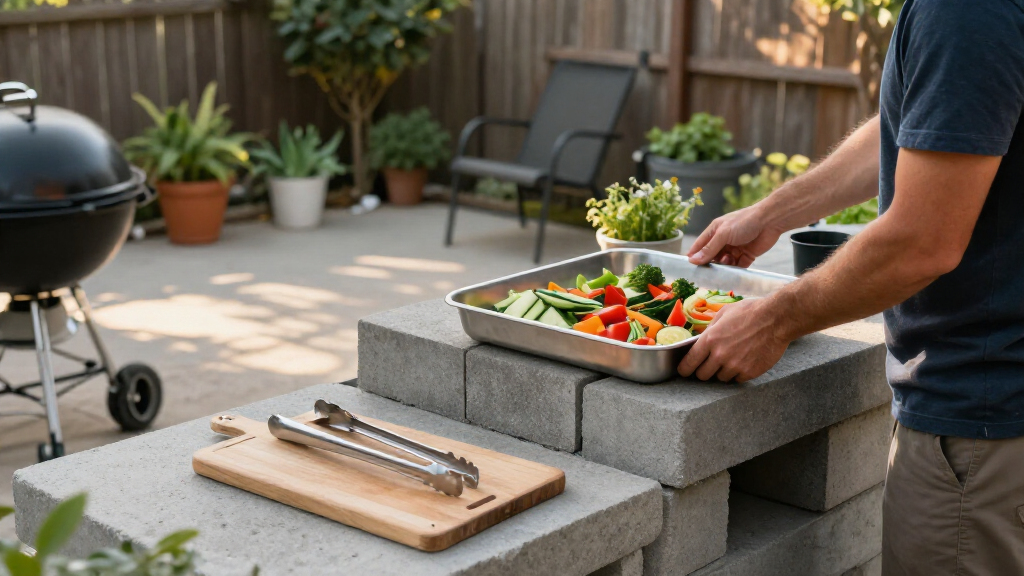
In the video series described by Hunker, the creator begins after a concrete foundation has been laid. He removes the grill’s side shelves, then arranges blocks around it to form an L-shaped counter with a recessed space for the grill to slide into. The blocks are initially dry-stacked, allowing the layout to be adjusted before it is secured.
The build uses several sizes: 8-by-8-by-16-inch hollow blocks, solid blocks measuring 4-by-8-by-16 inches and 2-by-8-by-16 inches, 8-by-8-by-8-inch half blocks, and concrete bricks. After marking the base with chalk, the creator applies surface bonding cement along the base blocks. He then stacks the remaining units and coats the structure with more of the cement, which the report says is used to hold the blocks together without mortar.
The source describes the materials and construction sequence but gives no complete shopping list or final project price. It also does not provide measurements for the finished counter or report how it performed after extended use. Those details will vary with the grill, available space and chosen layout.
A Flexible Option for Backyard Grilling
The approach shows how individual masonry units can be arranged to fit a particular backyard and grill, then fixed in place after the builder settles on a design. That flexibility may help people make a prep surface for a space where a prebuilt outdoor kitchen would not fit. The source also describes concrete blocks and bricks as noncombustible, a material property relevant around a cooking area; it does not establish that any specific layout meets local safety requirements.
Cost is a potential attraction, though the figures in the report are not a quote for this build. Hunker cites Range Outdoor Living’s estimate of $13,000 to $17,000 as the average price of a professionally installed outdoor kitchen. It also gives a price of just over $2 for a standard 8-by-8-by-16-inch block and under $20 for a 50-pound bag of surface bonding cement. The total for Mr. Greg’s project is not stated, and would depend on its size, materials and site preparation.
concrete blocks for outdoor grill counter
As an affiliate, we earn on qualifying purchases.
As an affiliate, we earn on qualifying purchases.
How the Block Counter Takes Shape
The method depends on planning the footprint before bonding the blocks. Dry stacking first lets the builder position the grill opening and counter shape without committing to a fixed arrangement. Once the base is outlined and the layout is set, the creator uses surface bonding cement at the base and as an exterior coating. Hunker says the cement contains added fiber to increase rigidity.
The foundation is an important part of the sequence: the video series, as summarized by Hunker, starts after it has already been laid. The report does not detail foundation specifications, local permitting, clearances from combustible materials, or instructions for connecting utilities. It presents the counter as a DIY project that does not require advanced masonry knowledge, but does not provide a complete assessment of every site or grill type.
“This kind of cement has added fiber to increase its structural rigidity and hold the blocks together.”
— Hunker, describing surface bonding cement
surface bonding cement for masonry projects
As an affiliate, we earn on qualifying purchases.
As an affiliate, we earn on qualifying purchases.
Project Cost and Durability Remain Unreported
The source does not state the total cost, counter dimensions, build duration or exact quantity of each block used. It also provides no follow-up on the structure’s durability, weather resistance or performance under repeated heat exposure. The cited block and cement prices are material examples, not a complete estimate for a finished installation.
Details about foundation design, grill clearances, permits and any utility work are also absent from the report. The described project is a masonry counter around a grill; the source does not establish that the same layout is suitable for every grill model or backyard.
outdoor grill prep station building kit
As an affiliate, we earn on qualifying purchases.
As an affiliate, we earn on qualifying purchases.
Builders Must Adapt the Layout to Site
The next step for anyone considering the design is to measure the available area and the grill, then dry-stack blocks to check the opening and counter footprint before applying cement. A project budget would need to account for the foundation, all masonry units, bonding cement and any additional site work. The source does not announce a follow-up video or a scheduled update on the creator’s build.
Because the report leaves construction and clearance specifications open, builders should check the grill manufacturer’s instructions and applicable local requirements before building around a cooking appliance. Whether the creator will publish cost details or long-term results remains unknown.
dry stacked concrete block outdoor kitchen
As an affiliate, we earn on qualifying purchases.
As an affiliate, we earn on qualifying purchases.
Key Questions
What materials did the creator use?
The build uses five types of masonry units: hollow 8-by-8-by-16-inch blocks, two sizes of solid blocks, 8-inch half blocks and concrete bricks. Surface bonding cement is applied at the base and over the assembled blocks.
How is the grill counter arranged?
The blocks form an L-shaped counter with a recessed opening for the grill. The creator first dry-stacks the blocks, then secures the base and coats the structure with surface bonding cement.
How much did this project cost?
The source does not report the project’s total cost. Hunker cites blocks at just over $2 each for a standard size and surface bonding cement at under $20 per 50-pound bag, alongside a separate $13,000-to-$17,000 estimate for professionally installed outdoor kitchens.
Does the report say the counter works with every grill?
No. The described design was arranged around the creator’s grill, and the source does not give dimensions or compatibility guidance for other models. The opening and clearances would need to be adapted to the specific grill and site.
Source: rss
Halloween Picks
halloween
As an affiliate, we earn on qualifying purchases.