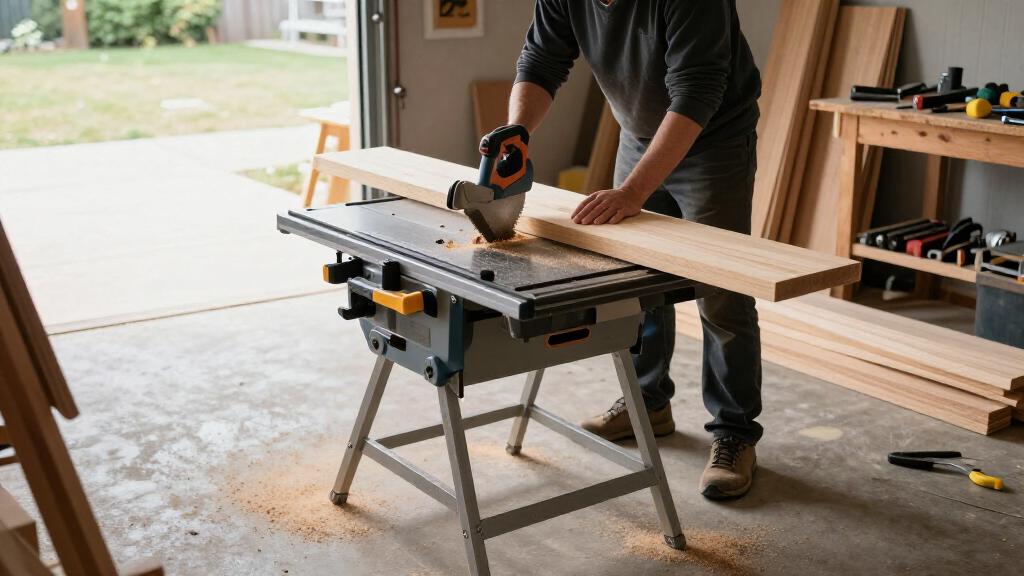

The best portable table saws balance cutting capacity, setup time, and easy transport without asking you to compromise more than your work requires. I rank the DEWALT DWE7491RS as the best overall for its 10-inch format and rolling stand, while the DEWALT DWE7485 is a strong compact pick and the SKIL SPT99-11 suits buyers who want a heavier-duty worm-drive design. The main tradeoff is straightforward: compact 8-1/4-inch saws are easier to move, while 10-inch models generally offer broader cutting utility but take more space. Stand design, fence adjustment, and the kind of sheet goods or lumber you cut also separate these options. Continue reading for the full breakdown and help matching a saw to your work.

Get business pricing on tools and workshop supplies
- Business-only prices and quantity discounts
- Tax-exempt purchasing
- Multiple users, one account, clear invoices
Complete the kit


Key Takeaways
- The DEWALT DWE7491RS leads for all-around jobsite use because its 10-inch blade and rolling stand combine useful capacity with easier movement than a stationary setup.
- The DWE7485 and compact SKIL 8-1/4-inch saw are portability-first choices; their smaller blade format can suit frequent transport, but buyers should check whether its cutting depth meets their project needs.
- The SKIL SPT99-11 stands apart from the lighter-duty compact options with its 10-inch worm-drive design and included stand, a fit for demanding work where carrying weight matters less.
- Several 10-inch choices prioritize different kinds of convenience: the DEWALT and Evolution pair full-size formats with wheeled stands, while the SKIL TS6307-00 uses a folding stand.
- Lower-profile alternatives such as the MarvTool and Garvee need closer feature checks; compare fence usability, stand stability, and available support rather than choosing on blade size alone.


| portable table saw | Motor | Power source | Rip capacity | Blade diameter |
|---|---|---|---|---|
| DEWALT 15 Amp 8-1/4-Inch Compa | 15 amp | — | 24.5 inches | — |
| SKIL 15-Amp 8-1/4-Inch Compact | 15 amp | Corded electric | 24.5 inches right; 12 inches left | 8-1/4 inches |
| SKIL 10-Inch Heavy-Duty Worm D | — | Corded electric | 30½ inches | 10 inches |
| MarvTool 10-Inch Portable Tabl | 15 amp | Corded electric | — | 10 inches |
| DEWALT 10-Inch Jobsite Table S | 15 amp | Corded electric | 32.5 inches | 10 inches |
| Evolution R10TBLX 10-Inch Jobs | 15A, 1800W | Corded electric | 26 inches | — |
| SKIL 15-Amp 10-Inch Jobsite Ta | 15A, 1800W | Corded electric, 120V | 25.5 inches | 10 inches |
| Garvee 10-Inch Table Saw with | 15A | Corded electric | — | 10 inches |
More Details on Our Top Picks
DEWALT 15 Amp 8-1/4-Inch Compact Portable Jobsite Table Saw (DWE7485)
I’d choose the DEWALT DWE7485 when carrying and storing a saw matters as much as cutting sheet goods. Its 24.5-inch rip capacity handles 4×8 plywood or OSB, while the rack-and-pinion fence makes width adjustments more controlled than a basic sliding fence. The metal roll cage and onboard accessory storage suit repeated moves between a vehicle, shop, and jobsite. Compared with the larger DEWALT DWE7491RS, this model gives up a 10-inch blade and some rip capacity, but is the more compact choice for transport. Its 8-1/4-inch blade also means less cutting depth than the bigger saws here. I’d favor it for portable sheet cutting, not for buyers who regularly need deeper cuts or a rolling stand included.
Pros:- 24.5-inch rip capacity accommodates 4×8 plywood and OSB cuts.
- Rack-and-pinion fence rails support quick, controlled adjustments.
- Compact format and metal roll cage suit frequent transport and storage.
- Onboard storage keeps accessories with the saw.
Cons:- The 8-1/4-inch blade offers less cutting depth than the 10-inch saws in this lineup.
- A stand is not listed among the included features, so a stable work setup may require a separate support.
- Its compact capacity is narrower than the DEWALT DWE7491RS for wide rip cuts.
Best for: Carpenters and DIYers who transport a saw often but still need enough rip capacity for full-size plywood and OSB.
Not ideal for: Buyers who routinely cut thick stock or want a 10-inch blade and rolling stand as part of the saw setup.
- Brand:DEWALT
- Model:DWE7485
- Motor:15 amp
- Blade size:8-1/4 inches
- Rip capacity:24.5 inches
- Base:Metal roll cage
- Safety feature:Power-loss reset prevents accidental restarts
Our verdict“Choose the DWE7485 if you want a sheet-capable jobsite saw that is easier to move and store than a full-size 10-inch model.”
SKIL 15-Amp 8-1/4-Inch Compact Portable Jobsite Table Saw
The SKIL 8-1/4-inch saw is a practical compact option for buyers who want a useful accessory package alongside full-size sheet-ripping capacity. Its 24.5-inch right rip capacity matches the DEWALT DWE7485, and the 12-inch left capacity adds flexibility for narrower cuts. At 40 pounds, it remains manageable to carry, while the aluminum table keeps the work surface light. The included push stick, guard system, anti-kickback pawl, miter gauge, and dust port elbow mean fewer basic accessories need to be sourced separately. Compared with the DEWALT, the tradeoff is that this model’s compatible folding stand is sold separately; a vacuum is also needed to use the dust port for extraction. Its 2.5-inch cut depth limits it against the 10-inch options.
Pros:- 24.5-inch right rip capacity and 12-inch left capacity cover a useful range of sheet and narrow cuts.
- Rack-and-pinion fence rails allow fast, accurate adjustments.
- Includes a guard system, anti-kickback pawl, push stick, and miter gauge.
- At 40 pounds, it is easier to move than the larger rolling-stand saws.
Cons:- The compatible folding stand is sold separately.
- A vacuum is required to make use of the dust port for extraction.
- Maximum 2.5-inch cut depth is less than the 10-inch saws offer.
Best for: DIYers and tradespeople seeking a portable, accessory-equipped saw for plywood and routine jobsite cuts, with a separate support available.
Not ideal for: Buyers who want a stand included, need deeper cuts, or expect dust collection without connecting a vacuum.
- Power source:Corded electric
- Motor:15 amp
- Wattage:1,800 watts
- Blade diameter:8-1/4 inches
- Maximum cut depth at 0 degrees:2-1/2 inches
- Rip capacity:24.5 inches right; 12 inches left
- Weight:40 pounds
- Table material:Aluminum
- Dust port connection:2-1/2 inches
Our verdict“Pick this SKIL for a portable sheet-cutting saw with a helpful included accessory set, provided you are willing to supply the stand and vacuum.”
SKIL 10-Inch Heavy-Duty Worm Drive Table Saw with Stand (SPT99-11)
For buyers who need a portable saw to handle larger, deeper cuts, the SKIL SPT99-11 offers a different balance from the lighter compact models. Its 10-inch blade, 3⅝-inch depth of cut, and 30½-inch rip capacity give it more room for thick stock and wide panels than the DEWALT DWE7485 or the 8-1/4-inch SKIL. The worm drive power train is aimed at delivering high torque, while the rolling stand, outfeed support, and left support help manage larger workpieces on site. That extra capability comes with a real portability penalty: at 94.3 pounds, it is heavy to lift, even with the rolling stand. I’d choose it over the compact saws for demanding cuts, but not for frequent solo loading or locations without an outlet.
Pros:- 10-inch blade and 3⅝-inch depth of cut handle thicker material than the compact saws.
- 30½-inch rip capacity accommodates wider workpieces than the 8-1/4-inch options.
- Rolling stand with 16-inch wheels supports movement around a jobsite.
- Outfeed and left-side supports help control larger cuts.
Cons:- At 94.3 pounds, it is demanding to lift and load.
- Corded operation limits use to locations with a suitable outlet.
- Its larger footprint is less convenient to store than the compact DEWALT DWE7485.
Best for: Framing crews and serious DIYers who need deeper cuts, broad rip capacity, and supports for handling large material at jobsites.
Not ideal for: Solo users who often lift a saw into a vehicle, or anyone needing cordless operation or a lightweight compact tool.
- Model:SPT99-11
- Blade diameter:10 inches
- Rip capacity:30½ inches
- Depth of cut:3⅝ inches
- Power source:Corded electric
- Voltage:120 volts
- Weight:94.3 pounds
- Blade:24-tooth carbide
- Warranty:1-year limited
Our verdict“Choose the SPT99-11 when cut depth and large-workpiece support matter more than low lifting weight.”
MarvTool 10-Inch Portable Table Saw, 15-Amp, 4600 RPM
The MarvTool MJT255VC1 stands out for pairing a 10-inch blade with a listed weight of just 28.3 pounds, far below the 94.3-pound SKIL SPT99-11 and 110-pound DEWALT DWE7491RS. That makes it appealing to buyers who want 10-inch blade capacity without committing to a heavy rolling-stand saw. It supports bevel cuts from 0 to 45 degrees, and its transparent guard and vacuum-compatible dust port address visibility and cleanup needs. The tradeoff is that the supplied details do not list a rip capacity or a stand, so I would not choose it for frequent wide-panel work without confirming the intended setup. Its 3.4-inch maximum depth at 90 degrees is useful, but this is a corded saw and still needs a stable work surface.
Pros:- Listed weight of 28.3 pounds is much lower than the larger rolling-stand saws.
- 10-inch blade reaches a 3.4-inch maximum cutting depth at 90 degrees.
- Supports bevel cuts from 0 to 45 degrees.
- Includes a transparent blade guard and vacuum-compatible dust port.
Cons:- Rip capacity is not specified in the supplied product data.
- A stand is not listed among the included components.
- Corded operation requires access to a power outlet.
Best for: DIYers who want a relatively light 10-inch saw for occasional cuts and bevel work, and can provide a sturdy support surface.
Not ideal for: Crews making frequent wide sheet cuts or buyers who need a listed rip capacity, included rolling stand, or cordless use.
- Model:MJT255VC1
- Blade diameter:10 inches
- Blade teeth:36
- Motor:15 amp
- Speed:4,600 rpm
- Maximum cutting depth at 90 degrees:3.4 inches
- Maximum cutting depth at 45 degrees:2.1 inches
- Weight:28.3 pounds
- Power source:Corded electric
Our verdict“Consider the MarvTool if low carry weight and a 10-inch blade are your priorities, but verify rip capacity and plan for a separate support.”
DEWALT 10-Inch Jobsite Table Saw with Rolling Stand (DWE7491RS)
I’d put the DEWALT DWE7491RS first for buyers whose portable-saw work regularly involves wide panels. Its 32.5-inch rip capacity exceeds the SKIL SPT99-11’s 30½ inches and the compact saws’ 24.5 inches, leaving more room for broad rips. The rack-and-pinion fence supports quick width changes, while the rolling stand is designed to simplify setup and movement between work areas. Onboard accessory storage and a dust port also help keep the jobsite setup together. This capacity comes at a substantial carrying cost: the saw weighs 110 pounds, making it the heaviest option here and a poor match for frequent solo lifting. Compared with the lighter MarvTool, it is a more complete rolling-stand setup for large work, but it takes more effort and space to transport.
Pros:- 32.5-inch rip capacity is the widest listed in this batch.
- Rack-and-pinion fence enables fast, controlled width adjustments.
- Rolling stand is designed for setup and movement around a jobsite.
- Onboard storage keeps accessories accessible, and the saw has a dust port.
Cons:- At 110 pounds, it is difficult to lift and load without help.
- Its larger rolling-stand setup takes more storage space than compact saws.
- Corded operation requires access to a power outlet.
Best for: Cabinet installers, remodelers, and woodworkers who cut wide sheet goods often and can move a heavy saw on its rolling stand.
Not ideal for: Solo users who need to lift a saw into a vehicle often, or buyers with limited storage space and mostly small workpieces.
- Model:DWE7491RS
- Power source:Corded electric
- Motor:15 amp
- Speed:4,800 rpm
- Blade diameter:10 inches
- Rip capacity:32.5 inches
- Cutting depth at 90 degrees:3-1/8 inches
- Weight:110 pounds
- Dust port:2-1/2 inches
Our verdict“Choose the DWE7491RS for frequent wide-panel cuts and rolling mobility, not for lightweight transport or compact storage.”
Evolution R10TBLX 10-Inch Jobsite Table Saw with Wheeled Stand
The Evolution R10TBLX is the most versatile choice here for buyers who need a portable saw to cut more than wood: its 15A motor is specified for wood, mild steel, aluminum, and composites. That range sets it apart from the SKIL TS6307-00, which is presented as a conventional wood-cutting jobsite saw. A collapsible wheeled stand also makes moving and storing this 10-inch model easier than a fixed-stand setup. The included dado plate, zero-clearance throat plate, and cross-cut sled add useful ways to configure cuts without sourcing those accessories separately. Its tradeoffs are real: it needs a corded outlet, and the 26-inch rip capacity may constrain wider sheet goods. Choose it for material flexibility, not maximum panel support.
Pros:- Specified to cut wood, mild steel, aluminum, and composites
- Collapsible wheeled stand supports easier transport and storage
- Includes dado and zero-clearance throat plates plus a cross-cut sled
- Electronic blade brake, riving knife, and anti-kickback pawls add safety features
Cons:- Corded power requires access to an outlet
- 26-inch rip capacity can limit handling of wider materials
Best for: Woodworkers and repair professionals who need one portable saw for wood plus occasional mild steel, aluminum, or composite cutting.
Not ideal for: Buyers who regularly rip wide sheet goods or need to work away from a powered outlet; its 26-inch rip capacity and corded design limit those jobs.
- Blade size:10 inches
- Motor:15A, 1800W
- Rip capacity:26 inches
- Maximum cut depth:3-3/8 inches
- Bevel range:0–45 degrees
- Stand:Collapsible wheeled stand
- Power source:Corded electric
- Warranty:3 years
Our verdict“Choose the Evolution R10TBLX if cutting several material types and rolling a 10-inch saw between work areas matter more than wide rip capacity.”
SKIL 15-Amp 10-Inch Jobsite Table Saw with Folding Stand (TS6307-00)
The SKIL TS6307-00 is a practical pick for buyers who want a 10-inch jobsite saw that folds away without making setup needlessly involved. Its integrated folding stand and 51.2-pound weight suit contractors or home renovators who move between work areas but still want a full-size blade. Rack-and-pinion fence rails make adjustments more direct than a basic sliding fence, while the 4×4-at-90-degree capacity gives it an advantage for posts and other thick stock. Compared with the Evolution R10TBLX, the SKIL is less geared toward multi-material work and does not include dado accessories; it is a more straightforward wood-cutting choice. The 25.5-inch rip capacity is close to Evolution’s, so neither is ideal for especially wide panels. Dado cuts require a separate blade set and insert.
Pros:- Folding stand supports transport and compact storage
- Rack-and-pinion fence rails allow straightforward adjustments
- Rated to cut 4×4 material at 90 degrees
- Dust port elbow redirects sawdust toward a collection hose
Cons:- Dado blade set and dado insert must be purchased separately
- Corded operation limits use away from an outlet
- 25.5-inch rip capacity may be restrictive for wide sheet goods
Best for: DIY renovators and jobsite users who need a folding 10-inch saw for framing stock, trim, and routine wood cuts.
Not ideal for: Buyers who want dado cutting accessories in the box or regularly rip wider panels; the dado set and insert are separate, and rip capacity is 25.5 inches.
- Blade diameter:10 inches
- Motor:15A, 1800W
- Rip capacity:25.5 inches
- Cutting capacity:4×4 at 90 degrees
- Bevel capacity:0–45 degrees
- Weight:51.2 lb
- Power source:Corded electric, 120V
- Included blade:10-inch, 24-tooth carbide blade
Our verdict“Pick the SKIL TS6307-00 for a folding, full-size jobsite saw suited to routine woodwork, especially when 4×4 cutting matters more than included dado capability.”
Garvee 10-Inch Table Saw with Stand
The Garvee 10-Inch Table Saw is a basic, stand-equipped option for buyers who want a saw ready for a home workshop rather than frequent jobsite moves. Its metal stand with triangle supports and side extensions are aimed at giving workpieces support around the saw, while blade-height adjustment and 0–45-degree bevel cuts cover common straight and angled cuts. At 45 pounds, it is lighter than the SKIL TS6307-00, but its listed 35 × 30 × 40-inch dimensions and stand make it less compact than a folding jobsite design. The 5,000-RPM motor specification is clear, though the provided data does not state a rip capacity or maximum cut depth, making capacity comparisons harder. A dust port is mentioned, but a collector is not listed as included. Choose this for straightforward setup, not a well-documented portability package.
Pros:- Metal stand includes triangle supports for stability
- Side extensions provide added support for larger workpieces
- Blade height and bevel angle are adjustable
- Includes a blade guard, push stick, rip fence, and miter gauge
Cons:- Listed dimensions and stand are less suited to compact storage than the SKIL TS6307-00’s folding setup
- Dust collector is not listed among the included components
- Provided product data does not specify rip capacity or maximum cut depth
Best for: Home DIY users who want a 10-inch corded saw with a stand and side extensions for occasional cuts in a stationary work area.
Not ideal for: Contractors who frequently transport their saw or buyers who need confirmed rip capacity, maximum cut depth, or dust-collection equipment in the box.
- Blade diameter:10 inches
- Motor:15A
- Speed:5,000 RPM
- Cutting angles:90-degree crosscut; 0–45-degree bevel
- Weight:45 lb
- Dimensions:35 × 30 × 40 inches
- Power source:Corded electric
- Included blade:24-tooth carbide-tipped blade
Our verdict“Choose the Garvee for occasional workshop cutting when an included stand and extensions matter more than fold-away portability or clearly stated cutting capacity.”
How We Picked
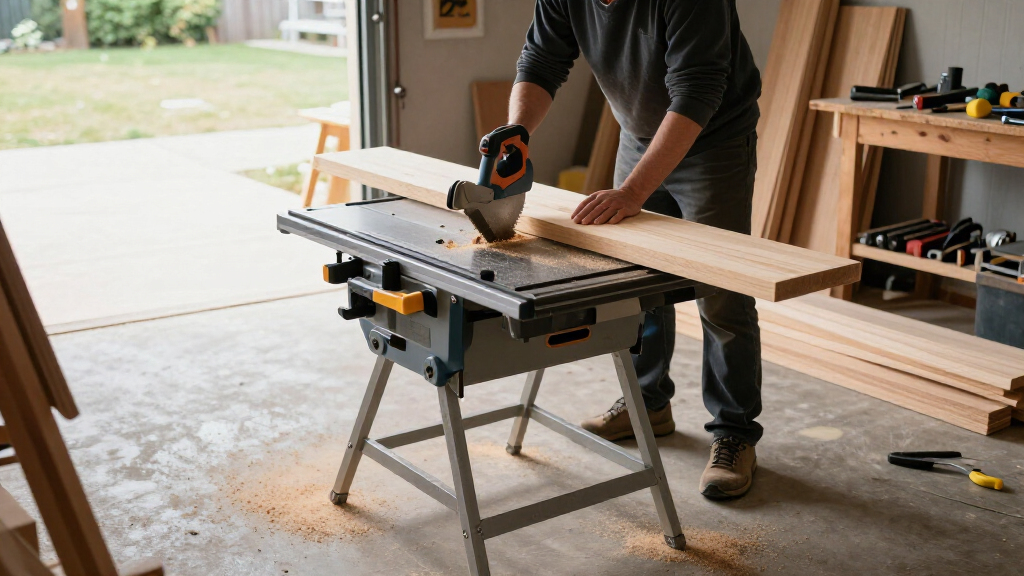
I ranked these saws by how well their design serves portable work: transport and setup, usable cutting capacity, fence and work support, and the balance between size and capability. A saw that is easy to carry but too limited for common cuts will not suit every job, while a larger model loses some appeal if moving or storing it becomes a regular hassle. I also weighed stand format, since rolling, folding, and separate stand designs change how quickly a saw can be put to work.
The ranking favors options with a clear, practical advantage for their intended buyer, rather than treating every 10-inch saw as interchangeable. The DEWALT DWE7491RS earns the all-around lead through its combination of full-size format and rolling mobility; compact models rank well for transport but give up some blade capacity. The SKIL SPT99-11 rates highly for buyers who value a more heavy-duty design, while MarvTool and Garvee sit lower because their appeal depends more on confirming the details that matter to a particular job. These are product comparisons based on stated design and features, not claims of hands-on testing.
| portable table saw | Model | Power source |
|---|---|---|
| DEWALT 15 Amp 8-1/4-Inch Compa | DWE7485 | — |
| SKIL 15-Amp 8-1/4-Inch Compact | — | Corded electric |
| SKIL 10-Inch Heavy-Duty Worm D | SPT99-11 | Corded electric |
| MarvTool 10-Inch Portable Tabl | MJT255VC1 | Corded electric |
| DEWALT 10-Inch Jobsite Table S | DWE7491RS | Corded electric |
| Evolution R10TBLX 10-Inch Jobs | — | Corded electric |
| SKIL 15-Amp 10-Inch Jobsite Ta | — | Corded electric, 120V |
| Garvee 10-Inch Table Saw with | — | Corded electric |
Factors to Consider When Choosing Portable Table Saws
Portable table saws are a compromise between a fixed workshop machine and a tool you can move when the work changes location. I would start with the cuts you make most often, then check whether the saw, stand, and storage plan can support that work. These broader factors can prevent a common mistake: buying by blade diameter alone.
Match Blade Size to the Cuts You Actually Make
An 8-1/4-inch blade can make sense when reduced size and transport matter more than maximum cut depth. A 10-inch model gives you a more familiar full-size format and may better suit thicker stock or a wider mix of projects. The bigger blade does not automatically make a saw the better choice: it can add bulk, and the saw still needs a capable fence and stable support. List the thickest material you expect to cut and check the stated cutting capacity before buying. If your work is mostly trim, panels, or occasional site cuts, a compact saw may cover it without carrying extra machine. For varied woodworking, the added range of a 10-inch format may justify the larger footprint.
Choose a Stand for Your Real Transport Routine
A rolling stand helps when one person regularly moves the saw across a site, but wheels do not remove the need for enough room to open and position the machine. A folding stand can take less storage space and suit a garage that doubles as a work area. A separate or more substantial stand may feel appealing for repeated stationary cuts, yet it can add setup steps and pieces to carry. Think about stairs, vehicle loading, doorways, and where the saw will be stored—not just whether it has wheels. Buyers sometimes focus on folded size and overlook the footprint during cutting. If you move the saw often, practice the imagined route from storage to work area before settling on a stand style.
Treat Fence Quality and Support as Core Cutting Features
Rip capacity gets attention, but a fence that is awkward to set or difficult to keep aligned can slow everyday work and affect cut consistency. Check how the fence locks, whether its adjustment suits the way you work, and what support is provided for wider material. A wide cut capacity is useful only if the workpiece can be controlled safely throughout the cut. In a compact setup, outfeed support or a helper may be needed for large sheets, even when the saw itself has generous capacity. Avoid assuming that a long table replaces safe material handling. If sheet goods are common, budget for a suitable support plan along with the saw.
Account for Weight, Setup, and Storage Together
Portability is not just a product label; it is the effort required to load, unfold, set up, use, and put the saw away. A heavier machine with a useful rolling stand may be easier to move across a flat site than a lighter saw that must be carried by hand. At home, the same machine may be inconvenient if its stand occupies the space needed for other tools. Measure both the stored footprint and the working footprint, including room for long stock to enter and leave the blade. Consider who will move the saw and how often, since a setup that works for occasional transport may frustrate daily use. Choose the least burdensome arrangement that still supports your typical workload.
Decide When Extra Capacity Is Worth the Bulk
Paying for a larger, more capable format makes sense when it regularly saves workarounds, supports thicker stock, or lets one saw handle a broader set of tasks. It is less compelling if most cuts are small and the machine needs to be carried between jobs. A compact saw can be a better purchase for punch-list work or limited storage, while a full-size model suits buyers who want a primary jobsite or garage saw. Do not pay for capacity you will rarely use if it makes transport harder every week. On the other hand, choosing too small a saw can lead to awkward setups for cuts it was never designed to handle. Let your most frequent demanding cut—not an occasional edge case—set the upper limit.
Check Safety and Service Details Before Committing
Portable saws need the same attention to safety as larger shop machines, especially because they may be set up in changing work areas. Review the included guarding and safety features, and check that replacement blades and routine maintenance items are readily available for the model. Dust collection matters in enclosed garages and occupied jobsites, so look at how the saw connects to your cleanup setup. Also consider whether the manual explains assembly, alignment, and maintenance clearly. A low-cost model can be a poor fit if parts or support are difficult to source later. These checks are particularly useful when comparing less familiar brands with established tool lines.
Frequently Asked Questions
Should I choose an 8-1/4-inch or 10-inch portable table saw?
Choose the 8-1/4-inch format when easier transport and compact storage matter most, and your usual materials fit its stated cutting capacity. A 10-inch saw is a stronger match for varied work or stock that calls for more cutting depth. The blade size alone does not tell you how well the saw handles a cut; fence control, support, and safe workpiece handling matter too. Compare your regular materials with the manufacturer’s capacity figures before deciding. In this roundup, the DWE7485 represents the compact approach, while the DWE7491RS and SPT99-11 show different 10-inch alternatives.
Is a rolling stand worth choosing over a folding stand?
A rolling stand is helpful when you move the saw frequently across a flat jobsite or need to reposition it without lifting the whole assembly. A folding stand can suit buyers who value compact storage and do not need to roll the saw long distances. Neither design removes the need to check setup space, stability, and the path between storage and work. Wheels may be less useful on stairs or rough ground, while a folding stand still requires lifting and unfolding. Match the stand to your actual transport route rather than treating one style as universally easier.
Can a portable table saw handle full sheets of plywood by itself?
A saw’s rip capacity does not mean it can safely support and control a full sheet on its own. Large panels need stable infeed and outfeed support, and their size can make handling difficult even with a capable saw. Plan for a suitable support table, rollers, or another safe method that keeps the panel level and controlled. If full-sheet breakdown is a frequent task, a track saw or panel-cutting setup may be more practical for the initial cuts. A portable table saw can then handle narrower, manageable pieces.
What should I check before choosing a less familiar portable saw brand?
Check the fence adjustment and locking method, stand stability, guard and safety components, and the stated cutting capacity. Look for clear instructions and confirm that blades and service parts can be obtained through accessible channels. Compare the complete setup rather than the saw body alone, since a stand or support system may affect how useful it is on site. If the product details leave key specifications unclear, that uncertainty is a real drawback for a tool you depend on for accurate cuts. The MarvTool and Garvee options make this kind of feature-by-feature verification especially relevant.
Which portable table saw makes sense as a first saw?
A first-time buyer should prioritize straightforward setup, a fence that is simple to adjust, stable support, and clear safety instructions over maximum capacity. A compact model can be easier to store and move, while a 10-inch saw may be more useful if the buyer expects varied projects. The SKIL TS6307-00 is a reasonable candidate to compare for its folding-stand approach, while the DEWALT DWE7485 is worth a look if a smaller format better fits the workspace. Before choosing, check the saw’s manual and included safety equipment, then budget for support for longer workpieces. The best first saw is one the buyer can set up safely and use for the projects they actually plan to tackle.
Conclusion
I would choose the DEWALT DWE7491RS as the best overall for buyers who want a 10-inch jobsite saw with rolling mobility. The best compact pick is the DEWALT DWE7485 when easier carrying and storage outweigh the smaller blade format; the compact SKIL is another option to compare. For buyers seeking a more heavy-duty design, the SKIL SPT99-11 is my premium-style choice, while the SKIL TS6307-00’s folding stand makes it a practical candidate for beginners who value a straightforward storage footprint. I would treat the MarvTool and Garvee as options for shoppers prepared to verify fence, stand, safety, and service details closely. For a different specific need, compare the Evolution R10TBLX if a wheeled 10-inch setup is your priority. Let your regular cut sizes and transport routine decide: the right portable saw is the one that fits both the work and the way you move it.
Halloween Picks
halloween
As an affiliate, we earn on qualifying purchases.