
TL;DR

Get business pricing on tools and workshop supplies
- Business-only prices and quantity discounts
- Tax-exempt purchasing
- Multiple users, one account, clear invoices
Dust mask ratings like N95, FFP2, and P3 show filtration capacity but don’t guarantee protection alone. Proper fit, correct usage, and matching the mask to the hazard are crucial for real safety. This guide breaks down what ratings mean and how to choose wisely.
Ever wonder if that cheap dust mask from the hardware store really protects you? Or if a paper N95 does enough for grinding concrete? The truth is, the rating on the box tells only part of the story. Your protection depends on the mask’s filtration, fit, and how long you wear it.
In this guide, you’ll learn what those ratings actually mean, how they relate to different trades, and the practical steps to keep your lungs safe. Because in the end, it’s not just about the label — it’s about making sure that mask actually shields you from the dust and fumes you breathe every day.
A mask’s rating indicates filtration capacity but doesn’t guarantee protection — fit and wearing time are equally critical.
For silica, asbestos, and heavy dust, always choose an FFP3 or P100 mask with a proper seal.
Fit testing isn’t just a formality — it’s a legal requirement for tight-fitting masks and can massively boost safety.
Reusable elastomeric masks and PAPRs are cost-effective and more reliable for continuous, high-hazard work.
Always verify your mask’s approval markings to avoid counterfeit gear that may give a false sense of security.
Trade PPE Guide · Respiratory Protection
Dust Mask Ratings for Tradespeople
N95, FFP2, P3 — the rating on the box tells only part of the story. Real protection comes from filtration, fit, and wearing the mask for the entire exposure. This guide decodes the standards, matches them to your trade, and shows how to keep your lungs safe on the job.
“A high rating like FFP3 or P100 only protects if the mask fits and is worn consistently — fit issues can cut real-world protection by over half.”
Three Rating Systems, One Goal
The numbers look similar but come from different test standards — they are not directly interchangeable. Know which system is printed on your mask.
42 CFR Part 84
American certification for particulate respirators. The letter tells you oil resistance; the number tells you filtration.
- N95 / N99 / N100 — filter 95% / 99% / 99.97% of particles
- N not oil-resistant · R somewhat · P oil-proof
- P-series matters with oil aerosols — machining mist, sprayed coatings
FFP1 · FFP2 · FFP3
The European standard for filtering facepieces. Suffix letters on the box tell you how the mask handles a full shift.
- FFP1 ≥80% · FFP2 ≥94% · FFP3 ≥99% filtration
- NR single shift · R reusable · D dolomite clogging tested
- D marking stays breathable in very dusty conditions — key for trades
Assigned Protection Factor
APF is the rating that actually connects mask to hazard — how much it reduces your exposure in real use.
- FFP1 = APF 4 · FFP2 = APF 10
- FFP3 = APF 20 — the construction-dust benchmark
- PAPR = APF 40 — for the heaviest exposure
Ratings vs. Real-World Uses
Filtration capacity, protection factor, and where each rating earns its place on site.
| Rating | Filtration | APF | Best Use | Silica / Asbestos? |
|---|---|---|---|---|
| N95NIOSH · US | 95% | ~10 | Light nuisance dust, some woodworking. Common and affordable — but not for high-concentration hazardous dust. | ✗ NoInsufficient for silica or asbestos work |
| FFP2EN 149 · EU/UK | ≥94% | 10 | Drywall, plaster, moderate dust, some hardwoods. Reliable European standard — needs a proper fit to deliver. | ~ Bare minimumLight, short tasks only — not recommended |
| FFP3 / P100EN 149 / NIOSH | ≥99% | 20 | Silica, hardwood & MDF, heavy grinding. High protection — must seal well; often reusable with replaceable P3 filters. | ✓ YesThe standard recommendation for silica |
| PAPRPowered · loose-fitting | ≥99.95% | 40 | Continuous high-hazard work, bearded workers, licensed asbestos tasks. Constant filtered airflow — no tight seal needed. | ✓ BestRequired for licensed asbestos work |
Pick the Right Mask in 3 Steps
Know Your Hazard
Silica, hardwood, asbestos, or nuisance dust? Type and concentration set the filtration level you need. Respirable silica particles are microscopic — and cause irreversible lung disease.
Match the Rating
Silica, hardwood, or asbestos: go FFP3 / P100. Drywall and lighter tasks: FFP2 / N95 usually suffices. Higher ratings add breathing resistance — balance protection with wearability.
Check Fit & Comfort
A well-fitting lower-rated mask beats a leaky high-rated one. Do a user seal check before every use — and if it’s uncomfortable, you won’t wear it for the full shift.
Fit & Wear Time Beat the Label
“An FFP3 with a poor seal protects worse than a well-fitted FFP2.”
- Facial hair breaks the seal. Even stubble lets silica dust sneak in around the edges — bearded workers need loose-fitting powered hoods.
- Fit testing is a legal requirement for tight-fitting RPE (UK HSE) — qualitative or quantitative, not a formality.
- Every use — do a user seal check each time you put the mask on. No exceptions.
- APF only counts at 100% wear time. Lifting the mask briefly in a dust cloud collapses your real-world protection.
- You can’t see the dangerous dust. The OSHA silica limit is 50 µg/m³ over 8 hours — an invisible quantity.
Match the Mask to the Hazard
Silica · concrete · engineered stone
Cutting, grinding, chasing. The engineered-stone silicosis crisis drove Australia’s world-first ban (July 2024).
Hardwood & MDF dust
Classified as carcinogenic. Fine particles penetrate deep into the lungs.
Asbestos — licensed work
Disposables are not adequate. Formal RPE programme required.
Drywall · plaster · nuisance dust
General low-toxicity dust at moderate concentrations.
Solvent vapours & welding fume
Particle masks do ✗ nothing against gases — a separate rating system (EN 14387).
Filtration Efficiency by Rating
Minimum filtration under standard test conditions — real protection depends on fit.
Assigned Protection Factor (UK HSE)
Achieved only when the mask is worn for 100% of the exposure time.
Disposable, Reusable, or Powered?
Disposables are handy but limited. For daily heavy-dust work, reusable systems deliver better seals, lower long-term cost, and less waste.
Disposable Masks
Convenient for occasional, light tasks — but rated for one shift only.
- Replace when moist, damaged, or hard to breathe through
- Fit degrades as straps loosen over the day
- Valved versions ease exhalation — but don’t protect others
Elastomeric Half-Mask
Reusable rubber/silicone facepiece with replaceable P3 / P100 filters.
- Superior, repeatable seal — holds fit over time
- Cheaper long-term; easy to clean and inspect
- Must be certified as a complete unit — no mixing parts
PAPR
Powered air-purifying respirator with a loose-fitting hood and continuous filtered airflow.
- Works with beards — no tight face seal needed
- Cool airflow reduces fatigue on long, hot jobs
- Higher upfront cost — consistent protection pays it back
Fake Masks Give False Confidence
Counterfeit N95s and FFP2s flooded the market after 2020. They can look identical to genuine gear but fail filtration tests — leaving you unprotected while you feel safe. Always verify before you trust.
Verify approval numbers on the NIOSH Certified Equipment List — no listing, no protection.
Look for the CE marking + 4-digit notified body number and EN 149 printed on every FFP mask.
No markings = walk away. Suspiciously cheap bulk listings online are the classic red flag.
From Hazard to Real Protection
Identify the Hazard
Silica, hardwood, asbestos, vapours — know what you’re breathing.
Match the Rating
FFP3 / P100 for high hazard; FFP2 / N95 for light dust.
Fit Test & Seal Check
Legal requirement for tight-fitting RPE — check every single use.
Verify Approval
NIOSH CEL or CE markings — weed out the counterfeits.
Wear It 100%
Full-shift wear is what turns a rating into real protection.
What Do Dust Mask Ratings Really Mean? Read This First
Dust mask ratings like N95, FFP2, and P3 are shorthand for how well a mask filters tiny airborne particles. In simple terms, an N95 blocks 95% of particles, while an FFP3 filters at least 99%. But these numbers come from different testing standards, so they’re not directly interchangeable.
Understanding these standards is crucial because they reflect different testing conditions, face-fit requirements, and performance expectations. For example, an N95 is tested primarily against non-oil-based particles in controlled environments, which may not account for real-world conditions like high humidity or oily fumes. FFP3 masks often undergo more rigorous testing, including resistance to synthetic blood, which indicates a higher level of protection against various hazards.
Knowing what these ratings mean helps you pick the right mask for the job. For cutting concrete or handling asbestos, a P3 or FFP3 is the safe bet due to their higher filtration standards and testing criteria. For drywall dust or nuisance particles, FFP2 or N95 usually suffices, but always consider the specific hazards and conditions you face.
As an affiliate, we earn on qualifying purchases.
How to Pick the Right Mask for Your Job in 3 Simple Steps
- Identify your hazard: Are you dealing with silica dust, wood, asbestos, or nuisance dust? The type and concentration matter because they influence the necessary level of filtration. For instance, silica dust particles are extremely small and can cause serious lung diseases, so a high-efficiency mask is necessary. Recognizing the hazard helps prioritize protection, but also influences comfort and practicality.
- Match the rating: For silica, hardwood, or asbestos, go for FFP3 or P100 masks, which provide the highest filtration efficiency and are often designed to resist oil-based and other challenging particles. For drywall or lighter tasks, FFP2 or N95 masks are generally sufficient, but always weigh the risk of exposure and duration of use. Remember that higher-rated masks often come with increased breathing resistance, so balancing protection with comfort is essential.
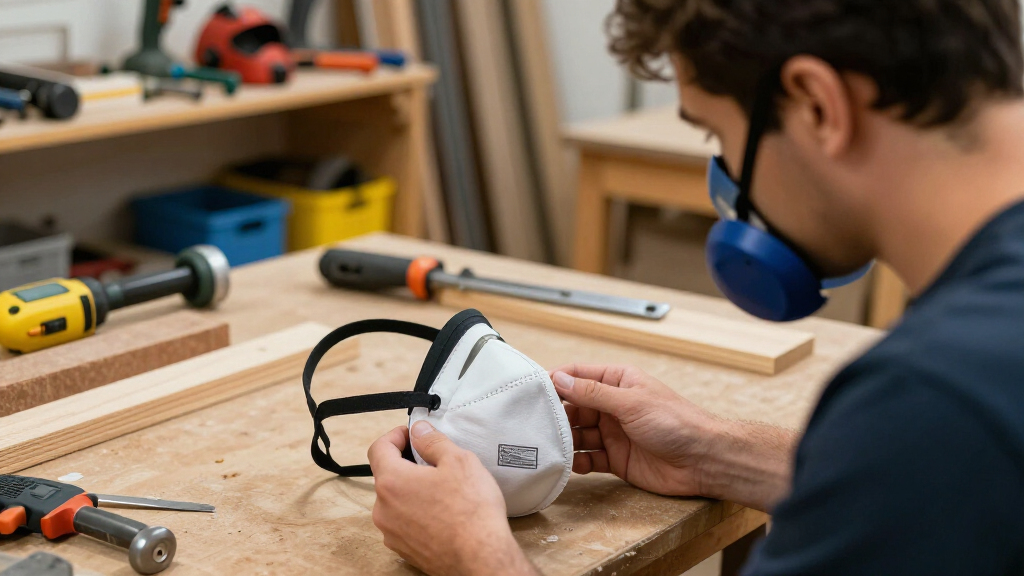
- Check fit and comfort: A well-fitting mask outperforms a higher-rated mask that doesn’t seal properly. Proper fit ensures that air doesn’t bypass the filter through gaps, which can drastically reduce effectiveness. Always do a user seal check before each use, and consider fit testing if your employer provides it. Comfort matters too—if a mask causes discomfort, you’re less likely to wear it consistently, undermining protection.
For example, if you’re cutting engineered stone countertops, your best bet is an FFP3 or P100 with a proper seal. For sanding drywall, an N95 or FFP2 usually suffices, but a good fit still matters because gaps can allow dust to bypass the filter, rendering the mask ineffective.
FFP3 respirator mask with proper fit
As an affiliate, we earn on qualifying purchases.
As an affiliate, we earn on qualifying purchases.
Comparison Table: Dust Masks vs. Their Ratings and Uses
| Rating System | Filtration Capacity | Best Use | Comments |
|---|---|---|---|
| N95 | 95% of particles ≥0.3 microns | Light nuisance dust, some woodworking | Common, affordable, but less protective for silica or asbestos. Suitable for general dust but not high-concentration or hazardous dusts. |
| FFP2 | ≥94% of particles | Drywall, moderate dust, some hardwoods | More reliable and European standard. Better suited for moderate exposure but may require proper fit for maximum protection. |
| FFP3 / P100 | ≥99% of particles | Silica, asbestos, heavy grinding | High protection, must fit well, often reusable. Ideal for high-risk environments but can be more uncomfortable for extended wear. |
As an affiliate, we earn on qualifying purchases.
Why Fit and Wearing Time Are Just as Important as Ratings
A mask’s rating is only half the story. Even the best filter won’t protect you if it doesn’t seal tightly to your face. Facial hair, improper donning, or movement can create leaks, reducing protection by over half. This means that even with a high-rated mask, poor fit can negate much of the filtration benefit, increasing the risk of inhaling hazardous dust.
For example, a worker with stubble on his chin might wear a P3 mask, but if it doesn’t seal, silica dust sneaks in around the edges, defeating the purpose. Fit testing ensures that the mask forms a proper seal against your face, accounting for unique facial features and ensuring maximum protection.
And don’t forget — a mask only works if you wear it for the entire exposure. Removing it briefly during a dust cloud can significantly reduce your protection, as new dust particles bypass the filter and enter your lungs. Consistent, correct use is essential for real safety.
industrial safety mask with filter
As an affiliate, we earn on qualifying purchases.
As an affiliate, we earn on qualifying purchases.
When and Why You Should Use Reusable Masks or Powered Air-Purifying Respirators
Disposable masks are handy but limited. For daily work with heavy dust or silica, elastomeric half-masks with P3 filters offer a superior fit, durability, and long-term value because they maintain their seal over time and are easier to clean and inspect. Powered air-purifying respirators (PAPRs) are even better for high-exposure tasks or when fit testing is challenging, as they provide a continuous flow of filtered air and do not rely solely on a tight seal.
Imagine a countertop fabricator with a beard — a PAPR with a loose-fitting hood keeps him protected without shaving, offering consistent protection regardless of facial hair. For workers grinding concrete daily or working in environments with prolonged exposure, a PAPR can reduce fatigue by providing cool, fresh air and ensure ongoing protection even if fit issues arise.
While initial costs are higher, these systems last longer, produce less waste, and provide consistent protection, making them a cost-effective choice over time for serious or continuous hazards.
The Risks of Counterfeit Masks and How to Spot Them
Counterfeit masks flood the market, especially after 2020. Fake N95s or FFP2s often fail filtration tests, leaving you unprotected. Always verify approval numbers on trusted databases like NIOSH or check for official CE markings. Counterfeit masks may look identical to genuine ones but lack the rigorous testing and certification, which can result in false confidence and increased health risks.
For example, a worker bought a cheap mask online, only to find it didn’t have a proper approval label. It looked real but provided little protection. Using unverified masks can be a false economy, as they may not filter out hazardous particles effectively, giving you a dangerous sense of security.
Stick to reputable suppliers, double-check approval markings, and avoid masks with suspicious packaging or missing certification details. Remember, genuine certification is your best safeguard against counterfeit products that compromise your health.
Frequently Asked Questions
Is an N95 mask enough for concrete cutting or sanding wood?
N95 masks provide 95% filtration but are primarily designed for nuisance dust. For silica or heavy wood dust, an FFP3 or P100 mask offers better protection. Fit and proper use are equally important.Can I wear a dust mask with a beard?
No. Facial hair breaks the seal of tight-fitting masks, reducing their effectiveness dramatically. Consider a powered hood or shaving for best protection.How long does a disposable mask last?
Typically one shift (about 8 hours). Replace it sooner if it becomes damp, damaged, or hard to breathe through. Always follow the manufacturer’s instructions.Do particle masks protect against gases or vapours?
No. Particle-rated masks only filter solids or liquids in aerosols. For fumes, solvents, or gases, you need a half-mask with gas/vapour cartridges.How do I know if my mask fits properly?
Perform a user seal check every time you wear it. For occupational use, get a formal fit test to ensure your mask creates a complete seal over your face.Conclusion
Remember, the label on your mask is just a starting point. The real protection comes from a well-fitting mask you wear consistently in the right conditions. Don’t forget: safety is a mindset, not just a rating.
Next time you suit up, double-check the fit, match the mask to your hazard, and stay protected. Your lungs will thank you for it — every day.
Fall Picks
fall essentials
As an affiliate, we earn on qualifying purchases.